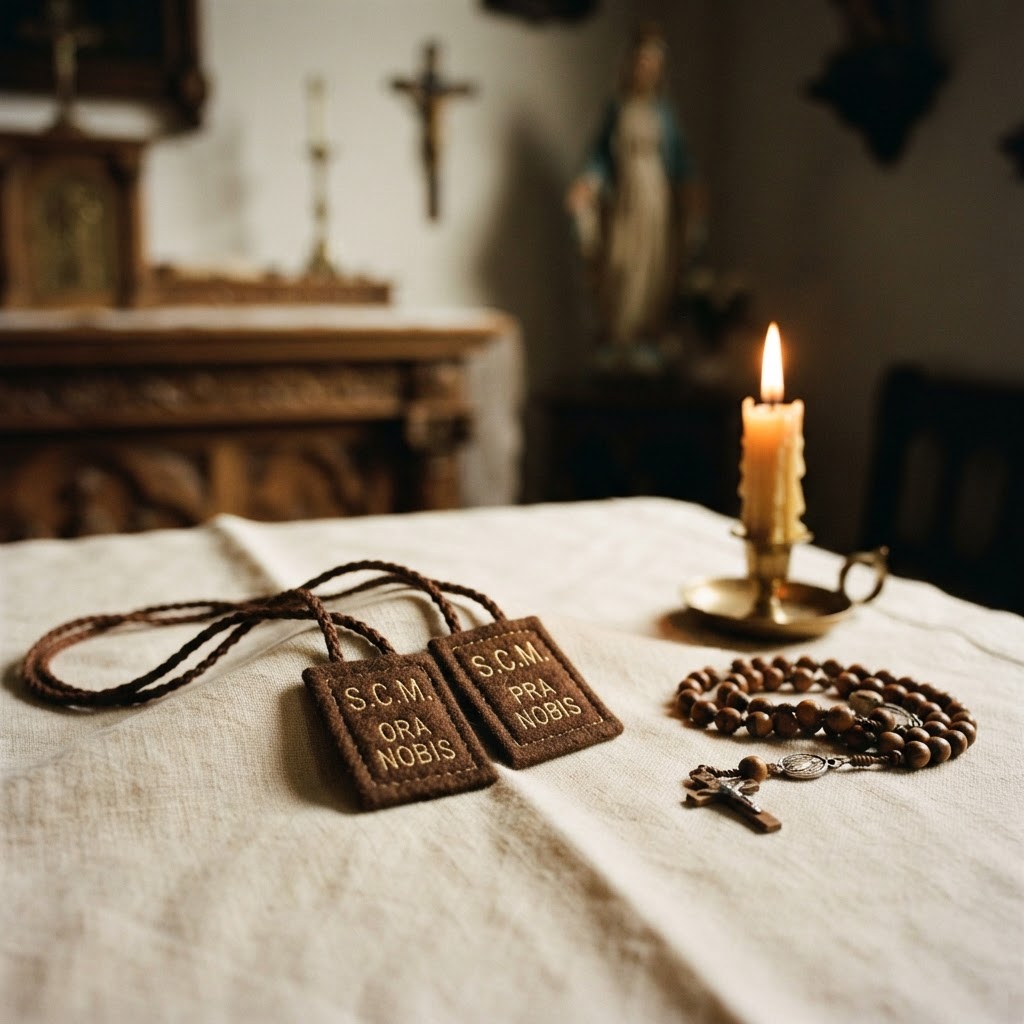
The Brown Scapular
Two Small Pieces of Cloth. A Centuries-Old Devotion. A Reminder That We Belong to Christ.
New to Catholicism?
The Brown Scapular isn't magic and it isn't a guaranteed ticket to Heaven. It's a Catholic sacramental — a physical reminder that we belong to Christ and desire to live under the maternal care and prayers of His mother.
Start With the Story ↓You may have seen a Catholic wearing what looks like a small brown necklace made of cord, with a little square of cloth hanging in the front and another in the back. It's called the Brown Scapular of Our Lady of Mount Carmel.
At first glance, it may seem strange. Why would someone wear pieces of brown cloth under their clothes? Does the Catholic Church really teach that wearing a scapular will get someone into Heaven? Is it a charm? What does Mary have to do with it? And what does any of this have to do with following Jesus?
Those are important questions — especially if you're exploring Catholicism.
The Brown Scapular is not magic. It isn't a guaranteed ticket to Heaven. And wearing one while deliberately rejecting Christ would completely miss its meaning. The Brown Scapular is a sacramental — an outward sign of devotion that reminds us of something much greater: We belong to Christ, and we want to live under the maternal care of His mother.
What Exactly Is a Scapular?
The little Brown Scapular Catholics wear today comes from something much larger. For centuries, members of religious orders have worn a garment called a scapular as part of their religious habit. The word comes from the Latin scapulae, meaning shoulders.
The original garment is a long piece of cloth worn over the shoulders, hanging down the front and back of the body. For religious men and women, the garment became associated with their religious vocation — a visible sign of dedication, service and belonging.
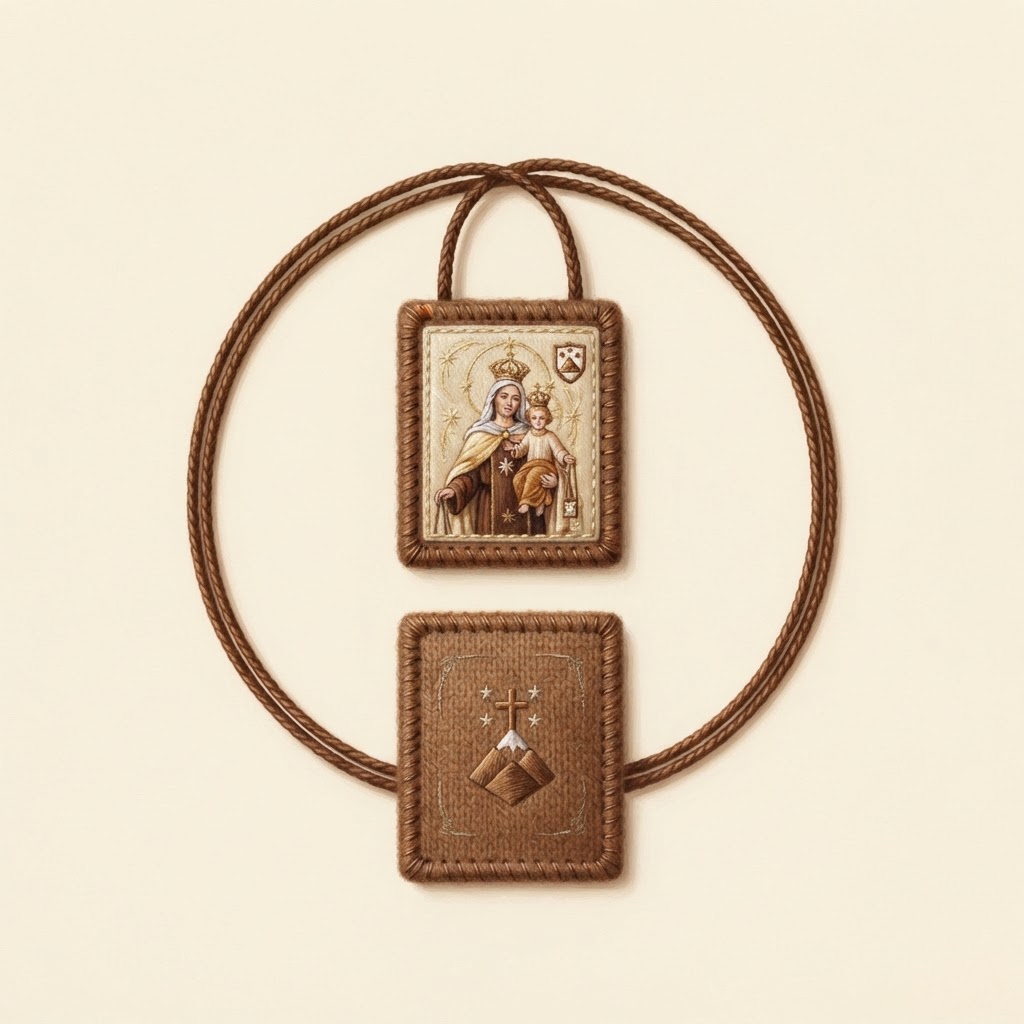
The small devotional scapular worn by lay Catholics developed from that tradition. It consists of two small pieces of brown wool connected by cords, with one piece traditionally worn over the chest and the other over the back. It is essentially a miniature version of the Carmelite religious garment.
What Exactly Am I Looking At?
Explore the parts of the Brown Scapular below — tap any piece to learn what it is, and see how it developed from the Carmelite religious habit.
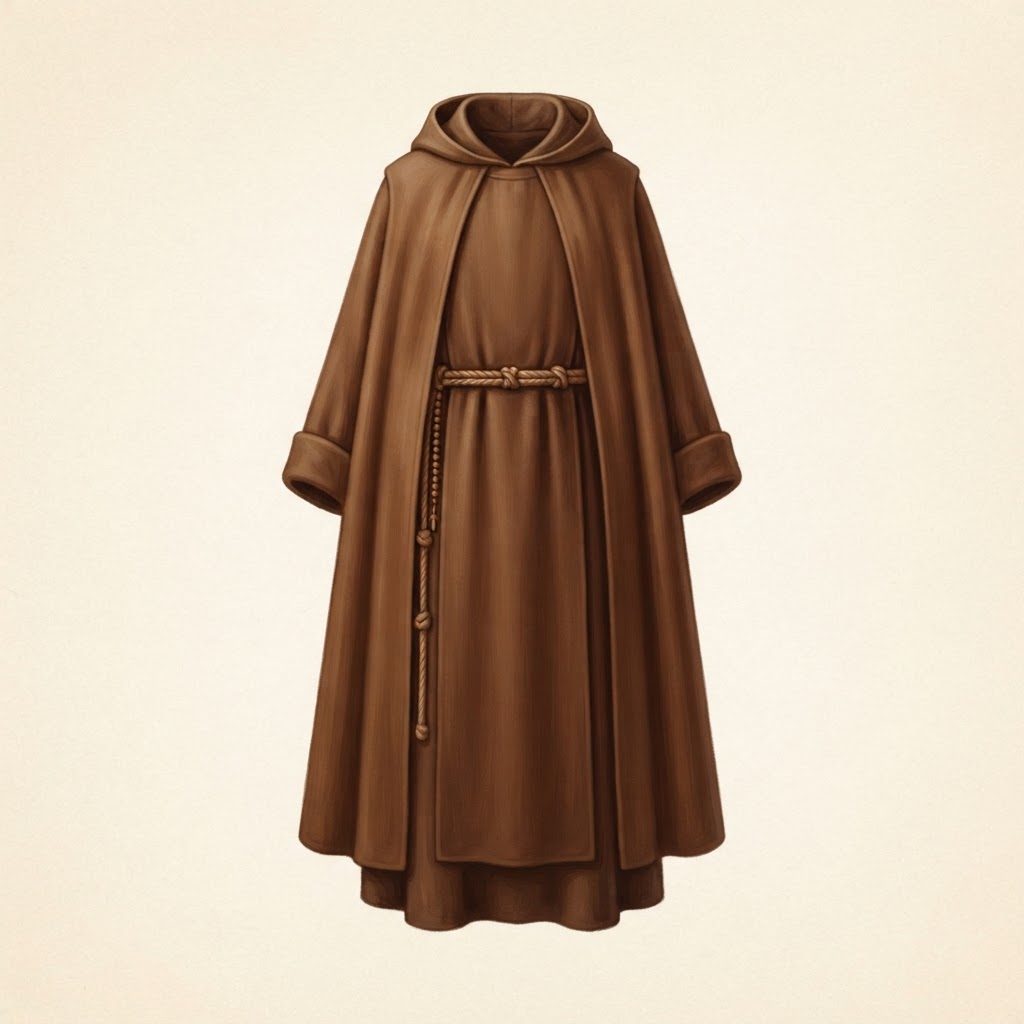
The Carmelite Habit
The small devotional scapular developed from this much larger religious garment, worn over the shoulders of Carmelite friars and nuns.
Front Piece
Traditionally worn over the chest. Together with the back piece, it forms the small devotional sign of belonging to Christ and of devotion to Our Lady of Mount Carmel.
Tap a part of the scapular to learn what it is.
Why Is It Called the Brown Scapular?
The Brown Scapular is associated with the Carmelite Order and therefore is also called the Brown Scapular of Our Lady of Mount Carmel. The Carmelites trace their spiritual heritage to Mount Carmel in the Holy Land.
Mount Carmel has deep biblical significance. It is especially associated with the prophet Elijah, whose confrontation with the prophets of Baal is recorded in 1 Kings 18. Centuries later, Christian hermits gathered on Mount Carmel to live lives dedicated to prayer and contemplation. These communities eventually developed into the religious order we know today as the Carmelites.
From the beginning, Carmelite spirituality developed a particularly strong devotion to the Blessed Virgin Mary. Their full traditional title reflects this: The Brothers of the Blessed Virgin Mary of Mount Carmel.
St. Simon Stock and the Scapular
Tradition associates the Brown Scapular with St. Simon Stock, a Carmelite who lived during the thirteenth century. According to Carmelite tradition, St. Simon experienced an apparition of the Blessed Virgin Mary in which she presented him with the Carmelite scapular. The traditional account associates Mary's protection with those who faithfully wear the Carmelite habit.
Over the centuries, devotion to the scapular spread beyond Carmelite monasteries and communities. Lay Catholics began wearing the smaller form of the scapular as a sign of their association with Carmelite spirituality and their devotion to Mary.
An Important Historical Note
When learning about Catholic devotions, it is important to distinguish between the truths of the Catholic faith and particular private revelations or devotional traditions. The Brown Scapular is an approved and longstanding Catholic devotion. However, historical details surrounding the traditional apparition to St. Simon Stock have been debated by historians because the earliest surviving accounts were written considerably later. Catholics are therefore not required to treat every detail of the traditional apparition account as an article of faith. The spiritual meaning of the scapular does not depend upon proving every historical detail of that story. Its enduring message is much simpler: Live as a disciple of Jesus Christ. Entrust yourself to Mary's prayers. Remember that you belong to God.
A Brief Timeline
Biblical Era
Mount Carmel becomes associated especially with the prophet Elijah.
12th–13th Centuries
Christian hermits on Mount Carmel develop into the Carmelite religious tradition.
13th Century
Carmelite tradition associates St. Simon Stock with the Brown Scapular.
Following Centuries
Scapular devotion spreads beyond Carmelite religious communities to lay Catholics.
Today
Catholics throughout the world wear the Brown Scapular as a sign of Carmelite spirituality and Marian devotion.
Biblical Era
Mount Carmel becomes associated especially with the prophet Elijah.
12th–13th Centuries
Christian hermits on Mount Carmel develop into the Carmelite religious tradition.
13th Century
Carmelite tradition associates St. Simon Stock with the Brown Scapular.
Following Centuries
Scapular devotion spreads beyond Carmelite religious communities to lay Catholics.
Today
Catholics throughout the world wear the Brown Scapular as a sign of Carmelite spirituality and Marian devotion.
Is the Brown Scapular Magic?
No. And this needs to be said clearly. The Brown Scapular is not:
- ✗ A magical charm
- ✗ A spiritual insurance policy
- ✗ A substitute for repentance
- ✗ Permission to live however you want
- ✗ A guarantee that someone can reject God and still go to Heaven
- ✗ More important than the Sacraments
- ✗ A replacement for a relationship with Jesus Christ
Catholic teaching rejects superstition. A person cannot knowingly reject Christ, refuse repentance, ignore the commandments and then expect two pieces of brown cloth to somehow force God to admit him into Heaven. That isn't Christianity. And it isn't what authentic scapular devotion means.
The scapular should instead remind the person wearing it: I belong to Christ. I need God's grace. I am called to conversion. I want to imitate Mary's faithfulness. I want to follow Jesus all the way home.
Does Wearing a Brown Scapular Guarantee Heaven?
No.
The Catholic Church does not teach that wearing an object allows someone to reject Christ and automatically receive salvation.
The scapular is the sign.
Jesus Christ is the Savior.
Scapular vs. Magic Charm
A Magic Charm
“An object has power that protects me regardless of how I live.”
The Brown Scapular
“A sacred sign reminding me to trust God's grace, live faithfully, pray and follow Jesus Christ.”
Catholicism rejects superstition. Sacramentals point beyond themselves toward God.
But Haven't I Heard That Wearing It Guarantees Heaven?
Probably. A statement frequently associated with the Brown Scapular is traditionally rendered: “Whoever dies wearing this scapular shall not suffer eternal fire.”
Taken completely by itself, that can sound as though wearing a particular object guarantees salvation. That is not how Catholics should understand the scapular. Salvation comes through Jesus Christ. The scapular is a sign of a person's desire to live in relationship with Christ and in devotion to His mother.
Think of it this way: a wedding ring represents a marriage. But simply wearing a wedding ring does not make someone a faithful spouse. A person could wear the ring while completely rejecting everything the marriage represents. The same principle applies here. Wearing the scapular while rejecting the Christian life contradicts the very thing the scapular represents. The scapular is a sign. Christ is the Savior.
Mary Always Points Toward Jesus
If you're investigating Catholicism, Marian devotion can initially seem confusing. Why so much attention to Mary? The answer begins with something Catholics believe very strongly: Authentic devotion to Mary leads us toward Jesus Christ — never away from Him.
Look at Mary's words in Scripture. At the wedding feast at Cana, Mary tells the servants: “Do whatever he tells you.” That could almost summarize authentic Marian spirituality. Mary does not say, “Look at me instead.” She points toward her Son: Do what He tells you. That is the spirit in which the Brown Scapular should be worn.
Wearing the Scapular Is Like Putting On a Garment
The symbolism of clothing runs throughout Scripture. St. Paul writes: “For as many of you as were baptized into Christ have put on Christ.” Elsewhere: “Put on the Lord Jesus Christ.” The scapular is literally something we put on. That makes its symbolism particularly beautiful.
Every morning, every evening, every ordinary moment when you notice the scapular against your skin can become a reminder: Have I put on Christ today? Am I living like someone who belongs to Him? Am I forgiving? Am I praying? Am I resisting sin? Am I loving my neighbor? Am I trusting God? Am I becoming the person Christ is calling me to become? Two little pieces of cloth can ask some very big questions.
The Biblical Ideas Behind the Scapular
The imagery of the scapular is rooted in Scripture — from “putting on Christ” to Mary's trust and her words at Cana.
“Put on the Lord Jesus Christ.”
Romans 13:14“For as many of you as were baptized into Christ have put on Christ.”
Galatians 3:27“Behold, I am the handmaid of the Lord; let it be to me according to your word.”
Luke 1:38“Do whatever he tells you.”
John 2:5“Behold, your mother.”
John 19:27“Elijah's confrontation with the prophets of Baal on Mount Carmel.”
1 Kings 18What Does the Brown Scapular Represent?
Belonging to Christ
Ultimately, every authentic Catholic devotion must lead to Jesus. The scapular reminds us that our lives are not entirely our own. Through Baptism we have become members of Christ. We belong to Him.
Mary's Motherly Care
Catholics believe that Jesus gave Mary a unique maternal relationship with His disciples. At Calvary, Jesus said to the beloved disciple: “Behold, your mother.” Catholics have traditionally understood these words as extending beyond John personally to Christ's disciples and the Church. Wearing the scapular expresses a desire to live beneath Mary's maternal care and to ask for her prayers.
Imitating Mary
Devotion to Mary isn't simply about asking her for things. It should make us want to become more like her. Mary trusted God. Mary obeyed God. Mary surrendered to God's will. At the Annunciation she said: “Behold, I am the handmaid of the Lord; let it be to me according to your word.” That attitude — “Let it be to me according to your word” — is at the heart of Christian discipleship. The scapular should remind us to give God our own yes.
Prayer
The Brown Scapular is closely associated with a life of prayer. It shouldn't simply hang around your neck unnoticed for twenty years. Let it remind you to pray. Touch it when you're afraid. Notice it when you're tempted. Remember it when you've sinned. Let it remind you to return to Confession. Let it remind you to pray for your family. Let it remind you that eternity matters.
What Is Our Lady of Mount Carmel?
Our Lady of Mount Carmel is a title given to the Blessed Virgin Mary in connection with the Carmelite Order. It is not a different Mary. Our Lady of Lourdes, Our Lady of Fatima, Our Lady of Guadalupe and Our Lady of Mount Carmel all refer to the same person: Mary, the mother of Jesus Christ. Different titles emphasize different events, apparitions, places or aspects of Catholic devotion.
The feast of Our Lady of Mount Carmel is celebrated on July 16.
What Is the Sabbatine Privilege?
If you've researched the Brown Scapular online, you may have encountered something called the Sabbatine Privilege. A popular version of this devotion claims that Mary promised to assist those devoted to the Brown Scapular — particularly on the Saturday following their death — in being released from Purgatory.
This subject requires some care. Historical questions surround the document traditionally associated with the Sabbatine Privilege, and Catholics should not treat it as though the Church guarantees automatic release from Purgatory on a particular Saturday. The deeper Carmelite tradition is much more meaningful than treating salvation like a contract. Those devoted to Our Lady of Mount Carmel trust in Mary's intercession, strive to live faithfully, pray and persevere in their relationship with Christ.
The focus should remain on: Christ. Conversion. Prayer. Grace. Perseverance. Not on trying to find a loophole in the Christian life.
What Does It Mean to Be Enrolled in the Brown Scapular?
Traditionally, someone beginning the Brown Scapular devotion is enrolled or invested in the scapular. This is ordinarily done by a priest or other authorized minister using the Church's approved rite. Enrollment isn't simply having someone bless a necklace. It expresses a person's intention to participate in the spirituality represented by the Brown Scapular and its connection with the Carmelite family.
After enrollment, the person wears the scapular as a continuing sign of that commitment. If you're interested, simply ask your parish priest: “Father, I'd like to be enrolled in the Brown Scapular. Can you help me?” He can guide you.
Does the Scapular Have to Be Brown Wool?
Traditionally, the Brown Scapular itself is made from brown wool. The two pieces are connected and worn so that one hangs in front and the other behind. Images or religious designs are commonly added, but the brown wool itself is the essential traditional material of the scapular.
After a person has been properly enrolled, the Church also permits a properly blessed scapular medal in circumstances recognized by Church discipline. However, many people choose to continue wearing the traditional cloth scapular because the garment itself carries the symbolism of the Carmelite habit.
What If My Scapular Breaks?
Don't panic. Nothing supernatural has suddenly happened because a cord broke. It's cloth. Cloth wears out. If an enrolled person's scapular becomes worn or breaks, it can simply be replaced. Because the devotion and enrollment pertain to the person rather than one particular physical object, you do not normally need to be enrolled again every time you replace a worn scapular.
Treat the old scapular respectfully because it is a sacramental. A common Catholic practice is to burn or bury blessed religious objects that can no longer be used rather than simply throwing them into the trash.
Do I Have to Wear It All the Time?
The tradition is to wear the Brown Scapular regularly as a sign of devotion and commitment. That is part of what gives the devotion meaning. It isn't intended merely to sit in a drawer. But don't become superstitious about it. If you remove it to shower, undergo a medical procedure, play a sport, replace a broken cord or for some other practical reason, you haven't suddenly abandoned God.
The point is not anxiety. The point is faithfulness.
Can Someone Who Isn't Catholic Wear a Brown Scapular?
Someone exploring Catholicism can certainly learn about the Brown Scapular and may wear one devotionally. But if you're not Catholic yet, don't feel as though you need to collect Catholic objects before understanding the faith. Start with Jesus Christ. Learn what Catholics believe. Attend Mass. Read the Gospels. Talk with a priest. Learn about OCIA. Ask questions. Pray.
The beautiful devotions of Catholicism make the most sense when they're understood within the larger life of the Church.
The Scapular and the Sacraments
The Brown Scapular should never become more important than the Sacraments. A scapular does not replace Baptism. It does not replace Confession. It does not replace receiving Jesus Christ in the Eucharist. It does not replace attending Mass. It does not replace repentance. It does not replace prayer. And it certainly does not replace Jesus.
Instead, wearing the scapular should encourage us toward all of those things. If your scapular reminds you that you've been away from Confession too long, it's doing its job. If it reminds you to pray when you've forgotten God all day, it's doing its job. If it reminds you to resist a temptation, it's doing its job. If it reminds you to forgive somebody, it's doing its job. If it reminds you that someday you will stand before God, it's doing its job.
A Simple Prayer
You don't need complicated words. If you wear the Brown Scapular, you might simply pray:
Blessed Mother,
keep me close to your Son.
Pray for me when I am weak.
Help me to say yes to God as you did.
Lead me always toward Jesus,
and help me remain faithful to Him
until the end of my life.
Amen.
Or simply pray the ancient Carmelite prayer: Our Lady of Mount Carmel, pray for us.
Don't Wear It as an Insurance Policy
There is a temptation with religious objects to start thinking transactionally. If I wear this, God has to protect me. If I say this prayer, God has to give me what I want. If I die wearing this, God has to let me into Heaven.
That's not faith. God isn't a vending machine, and sacramentals aren't spiritual currency. The Brown Scapular should represent a relationship. It should represent a life that says: Jesus, I belong to You. Mary, help me remain close to your Son.
And when we fail — because we will — it should remind us where to go: Back to Christ. Back to prayer. Back to Confession. Back to the Eucharist. Back home.
Two Pieces of Cloth — And a Much Bigger Question
The Brown Scapular is remarkably simple. Two little pieces of brown cloth. A couple of cords. Nothing expensive. Nothing impressive. And perhaps that's appropriate. Because Christianity isn't ultimately about what we wear around our neck. It's about what happens in our hearts and how we live our lives.
The scapular simply stays there, quietly reminding us: You belong to Christ. Live like it. And when you stumble: Get back up and follow Him again.
Want to Learn More?
Who Is Mary?
Why do Catholics honor Mary, and what does the Church actually teach about her?
Learn About Mary →The Miraculous Medal
Discover the story and symbolism behind another beloved Catholic sacramental.
Explore the Miraculous Medal →What Is Confession?
Learn why Catholics confess their sins and experience Christ's forgiveness in the Sacrament of Reconciliation.
Learn About Confession →How Do I Become Catholic?
If God seems to be drawing you toward the Catholic Church, discover what your next step can be.
Becoming Catholic →Maybe You're Here for More Than the Scapular
Perhaps you searched for the Brown Scapular because someone gave you one.
Maybe you saw someone wearing one.
Maybe you've recently started praying.
Or maybe, for reasons you can't completely explain, you keep finding yourself drawn toward the Catholic Church.
Don't ignore that curiosity.
You don't need to know everything before walking through the doors of a Catholic parish. Come and see.
Frequently Asked Questions
What is the Brown Scapular?
The Brown Scapular of Our Lady of Mount Carmel is a Catholic sacramental associated with Carmelite spirituality. The small devotional scapular consists traditionally of two pieces of brown wool worn over the shoulders and represents devotion to Mary and a commitment to following Jesus Christ.
Does wearing the Brown Scapular guarantee salvation?
No. The Brown Scapular is not a magical guarantee of salvation. Salvation comes through Jesus Christ. Authentic scapular devotion calls Christians toward faith, conversion, prayer and perseverance in the Christian life.
Is the Brown Scapular magic?
No. Catholic teaching rejects superstition. The scapular does not possess magical power. It is a sacramental intended to encourage faith and devotion.
Do Catholics worship Mary by wearing the scapular?
No. Catholics worship God alone. Catholics honor Mary as the mother of Jesus Christ and ask for her intercession.
What is Our Lady of Mount Carmel?
Our Lady of Mount Carmel is a title for the Blessed Virgin Mary associated with the Carmelite Order and its origins on Mount Carmel in the Holy Land.
Who was St. Simon Stock?
St. Simon Stock was a medieval Carmelite traditionally associated with the Brown Scapular devotion. Carmelite tradition recounts an apparition in which the Virgin Mary presented him with the scapular.
What is enrollment in the Brown Scapular?
Enrollment, sometimes called investiture, is the formal reception of a person into the Brown Scapular devotion using the Church's approved rite.
Do I need a new blessing when my scapular breaks?
Ordinarily, someone who has already been enrolled does not need to be enrolled again simply because a scapular wears out and is replaced.
Can a non-Catholic wear a Brown Scapular?
Someone exploring Catholicism may wear a scapular devotionally, although its fullest meaning is understood within Catholic sacramental and Carmelite spirituality.
Thinking About Becoming Catholic?
You don't have to have it all figured out before you begin.