The Rosary
A String of Beads. A Journey Through the Life of Christ. A Prayer That Leads to Jesus.
New to Catholicism?
The Rosary isn't magic, and it isn't a prayer to Mary instead of God. It's a sacramental — a sacred way of meditating on the life, death, and Resurrection of Jesus Christ, with Mary as our companion on the journey.
You may have seen a Catholic holding a string of beads, quietly moving from one bead to the next, lips murmuring prayers. You may have wondered: What are they doing? Why repeat the same prayers? Is it just a ritual — or is there something deeper?
That string of beads is called a Rosary. And behind it is one of the most beloved prayers in the Catholic Church — a prayer that has shaped saints, comforted the suffering, and led countless souls closer to Jesus Christ for nearly eight hundred years.
The Rosary is not a magic formula. It is not a prayer to Mary instead of God. Catholics do not worship the beads, and we do not believe the beads have power of their own. The Rosary is a sacramental — a sacred prayer that helps us meditate on the life of Jesus Christ.
And at its heart, the Rosary is not really about Mary. It is about Jesus.
What Is the Rosary?
The Rosary is a Scripture-based prayer. As Catholics pray it, they meditate on the key moments of the life, death, and Resurrection of Jesus — moments the Church calls mysteries. While the mind rests on these mysteries, the lips pray familiar prayers: the Our Father, the Hail Mary, and the Glory Be.
The beads serve a simple purpose: they keep count, freeing the heart to meditate. Think of them like the rails of a path — the beads guide the prayer forward while the mind walks with Christ through His life.
The Rosary is sometimes called a “Gospel on a string.” That is a beautiful description. If you pray the Rosary, you are walking through the life of Jesus — His birth, His ministry, His suffering, His death, and His rising again.
Is the Rosary Magic?
No. This distinction matters.
The Catholic faith rejects superstition — the idea that an object or a formula possesses power independent of God. The beads of the Rosary are not a charm. The repeated prayers are not an incantation. There is no magic in the metal, wood, or string.
Think about a love letter. The paper itself does not love you. But the words on the paper carry the heart of the one who wrote them. A crucifix works similarly — the wood does not save us, Jesus Christ saves us, and the crucifix reminds us of Him. The Rosary is the same. The beads guide the prayer; the prayer lifts the heart to God.
The Rosary has power only insofar as it leads us toward Jesus Christ. And that is exactly what it does.
Is the Rosary Magic?
No.
The Rosary has no magical power. Catholics trust in God alone. The beads are a sacramental that helps us meditate on the life of Jesus and directs our hearts toward Christ.
What Is a Sacramental?
The Catholic Church uses the word sacramental for certain sacred signs and devotional objects that help prepare us to receive God's grace and live our faith more deeply.
- ✦ Crucifixes
- ✦ Holy water
- ✦ Blessed palms
- ✦ Rosaries
- ✦ Scapulars
- ✦ Sacred medals
Sacramentals are different from the seven Sacraments instituted by Christ. The Rosary does not replace Baptism. It does not replace Confession. It does not replace the Eucharist. And it certainly does not replace a relationship with Jesus Christ.
Instead, sacramentals help direct our attention toward God and remind us to live the faith we profess.
The Story of the Rosary
According to Catholic tradition, the Rosary was given to St. Dominic in the early thirteenth century. Dominic was a priest and preacher laboring to bring souls back to Christ. Tradition holds that the Blessed Virgin Mary appeared to him and gave him the Rosary as a tool for prayer and preaching.
Whether one accepts the tradition of the apparition or not, the historical development is clear: by the late Middle Ages, the Rosary had taken shape as a prayer for ordinary people — many of whom could not read — to meditate on the life of Christ. The beads allowed the illiterate to pray the Psalms alongside the monks, in spirit, by repeating the prayers of Scripture.
The Rosary was popularized further by Bl. Alan de la Roche in the fifteenth century and promoted by Pope after Pope, including St. Pius V, who credited the Rosary with the Christian victory at the Battle of Lepanto in 1571. That victory gave us the feast of Our Lady of the Rosary, celebrated on October 7.
In 2002, Pope St. John Paul II added a fourth set of mysteries — the Luminous Mysteries — to help Catholics meditate on the public ministry of Jesus. He called the Rosary “a compendium of the Gospel.”
The Mysteries of the Rosary
The Rosary leads us through twenty moments from the life of Jesus, grouped into four sets of mysteries. Each mystery is a passage from the Gospels.
The Joyful Mysteries
(Mondays & Saturdays)
The Annunciation
Luke 1:26–38
The angel Gabriel appears to Mary, and she says yes to God's plan.
The Visitation
Luke 1:39–56
Mary visits her cousin Elizabeth, who calls her 'blessed among women.'
The Nativity
Luke 2:1–20
Jesus is born in Bethlehem and laid in a manger.
The Presentation
Luke 2:22–40
Mary and Joseph present Jesus in the Temple.
The Finding in the Temple
Luke 2:41–52
The young Jesus is found teaching in His Father's house.
The Sorrowful Mysteries
(Tuesdays & Fridays)
The Agony in the Garden
Matthew 26:36–46
Jesus prays in Gethsemane, accepting the Father's will.
The Scourging at the Pillar
John 19:1
Jesus is scourged for our sins.
The Crowning with Thorns
Matthew 27:27–31
Jesus is mocked with a crown of thorns.
The Carrying of the Cross
John 19:17
Jesus carries His Cross to Calvary.
The Crucifixion
John 19:18–30
Jesus gives His life for our salvation.
The Glorious Mysteries
(Wednesdays & Sundays)
The Resurrection
John 20:1–18
Jesus rises from the dead on the third day.
The Ascension
Acts 1:6–11
Jesus ascends into Heaven.
The Descent of the Holy Spirit
Acts 2:1–13
The Holy Spirit descends upon the Apostles at Pentecost.
The Assumption
Revelation 12:1
Mary is taken body and soul into Heaven.
The Coronation
Revelation 12:1
Mary is crowned Queen of Heaven and Earth.
The Luminous Mysteries
(Thursdays)
The Baptism of Jesus
Matthew 3:13–17
The Father reveals Jesus as His beloved Son.
The Wedding at Cana
John 2:1–11
Jesus performs His first public miracle at Mary's request.
The Proclamation of the Kingdom
Mark 1:14–15
Jesus calls us to repentance and belief in the Gospel.
The Transfiguration
Matthew 17:1–8
Jesus reveals His divine glory to Peter, James, and John.
The Institution of the Eucharist
Luke 22:14–20
Jesus gives us His Body and Blood at the Last Supper.
Is the Rosary Biblical?
Yes. Every prayer of the Rosary and every mystery comes from Scripture.
The Our Father was taught by Jesus Himself (Matthew 6:9–13). The Hail Mary is built from the words of the angel Gabriel and Elizabeth (Luke 1:28, 42). The Glory Be praises the Trinity, the central mystery of the Christian faith.
And the mysteries are the Gospel. The Annunciation, the Nativity, the Crucifixion, the Resurrection — every one is a passage from the life of Christ. To pray the Rosary is to pray the Scriptures.
Why Do Catholics Ask Mary to Pray for Them?
This may be the biggest question for someone investigating Catholicism. Catholics do not pray to Mary because we believe she is God. She isn't.
Catholics ask Mary to pray for us because we believe the members of Christ's Church remain united in Him. If you were struggling, you might ask a faithful friend, “Will you pray for me?” Catholics believe death does not destroy the Body of Christ. Those alive with Christ in Heaven have not stopped loving God or loving us.
So when a Catholic says, “Mary, pray for me,” we are asking for intercession. The distinction is simple: We worship God. We ask the saints to pray with us and for us. And among all the saints, Mary holds a unique place because she is the mother of Jesus.
In the Rosary, Mary is not the destination. She is the companion. She walks with us through the life of her Son — because no one knew Him better, loved Him more, or followed Him more faithfully.
The Fifteen Promises of the Rosary
According to tradition, the Blessed Virgin Mary made fifteen promises to St. Dominic and Bl. Alan de la Roche for those who faithfully pray the Rosary. These promises are a source of encouragement — not a guarantee of an easy life, but an assurance of Mary's intercession and God's grace for those who seek Christ through this prayer.
- 1Whoever shall faithfully serve me by the recitation of the Rosary shall receive signal graces.
- 2I promise my special protection to those who pray the Rosary.
- 3The Rosary shall be a powerful armor against hell; it will destroy vice, decrease sin, and defeat heresies.
- 4It will cause virtue and good works to flourish; it will obtain for souls the abundant mercy of God.
- 5Those who recommend themselves to me by the recitation of the Rosary shall not perish.
- 6Whoever shall recite the Rosary devoutly shall never be conquered by misfortune.
- 7Whoever shall have a true devotion for the Rosary shall not die without the Sacraments of the Church.
- 8Those who are in the habit of praying the Rosary shall have, during their life and at their death, the light of God and the plenitude of His graces.
- 9I shall deliver promptly from Purgatory souls devoted to the Rosary.
- 10The faithful children of the Rosary shall merit a high degree of glory in Heaven.
- 11You shall obtain all that you ask of me by the recitation of the Rosary.
- 12All those who propagate the Holy Rosary shall be aided by me in their necessities.
- 13I have obtained from my Divine Son that all the advocates of the Rosary shall have for intercessors the entire celestial court during their life and at the hour of death.
- 14All who recite the Rosary are my sons and daughters, and brothers and sisters of my only Son Jesus Christ.
- 15Devotion to my Rosary is a great sign of predestination.
These promises are a tradition of devotion, not a defined dogma. They encourage us to trust in God's grace and Mary's intercession, not to treat the Rosary as a transaction.
Why Pray the Rosary?
Catholics pray the Rosary for many reasons. It can be a way to begin the day with Christ. A way to calm an anxious heart. A way to pray when words run out. A way to walk with Jesus through His life when life feels overwhelming.
Many Catholics pray the Rosary in times of trouble — illness, grief, fear, decision. Others pray it daily as a steady rhythm of devotion. Some pray it in the car, some before the Blessed Sacrament, some with their families at night.
And sometimes it becomes something even simpler: a reminder that you are not walking through life alone. Every bead is an invitation to turn your heart back toward Christ. Pray. Trust. Repent when necessary. Ask Mary to pray for you. And follow her Son.
Do I Need to Be Catholic to Pray the Rosary?
No. Anyone may pray the Rosary. In fact, it can be a wonderful place to begin if you are exploring the Catholic faith. You don't have to understand every Catholic teaching before you begin to pray.
You can simply pray: “Jesus, if the Catholic faith is where You are leading me, show me. Give me the courage to follow the truth wherever it leads.” And you can ask Mary: “Mary, Mother of Jesus, pray for me. Help me know and follow your Son.” That is a beautiful place to begin.
Should the Rosary Be Blessed?
Catholics traditionally have rosaries blessed by a Catholic priest or deacon. The blessing does not turn the beads into a magical object. Rather, the blessing dedicates the object to sacred use and asks God to bless the person who prays with it faithfully.
If you have a Rosary that has never been blessed, simply bring it with you to a Catholic parish and ask a priest or deacon if he would bless it. Don't worry if you aren't Catholic. Just tell him you're learning about the faith. He'll understand.
A Simple Prayer
If you're holding a Rosary for the first time, you don't need an elaborate prayer. Begin with the prayer Mary herself gave us in Scripture:
Hail Mary, full of grace, the Lord is with you.
Blessed are you among women,
and blessed is the fruit of your womb, Jesus.
Then speak to Jesus. Tell Him what you're afraid of. Tell Him where you've failed. Tell Him what you don't understand. Ask Him for forgiveness. Ask Him for faith. Ask Him to show you the truth. And then be willing to follow where He leads.
Ready to learn how to pray the whole Rosary? Here is a step-by-step guide.
The Rosary Always Leads to Christ
The Rosary isn't really about the beads. It isn't ultimately even about the repetition. It points toward something much bigger. Mary points toward Christ. Christ points us toward the Father. And through Christ, we are invited into a life of grace — through faith, repentance, Baptism, the Eucharist, Confession, prayer, and life within His Church.
So if someone gives you a Rosary, don't simply set it aside. Hold it. Learn what the mysteries mean. Pray it if you wish. And let that string of beads ask you a much bigger question: Where is God calling you?
Want to Learn More?
How to Pray the Rosary
Ready to begin? A step-by-step guide to praying the Rosary, including the prayers and the mysteries.
Learn How to Pray →Who Is Mary?
Learn why Catholics honor the Mother of Jesus and what the Church actually teaches about Mary.
Learn About Mary →The Brown Scapular
Explore another beloved Catholic sacramental — two pieces of cloth and a devotion to Our Lady of Mount Carmel.
Explore the Brown Scapular →The Miraculous Medal
Discover the story behind another Marian sacramental — a small medal that reminds us to trust in God.
Explore the Medal →Are You Exploring the Catholic Faith?
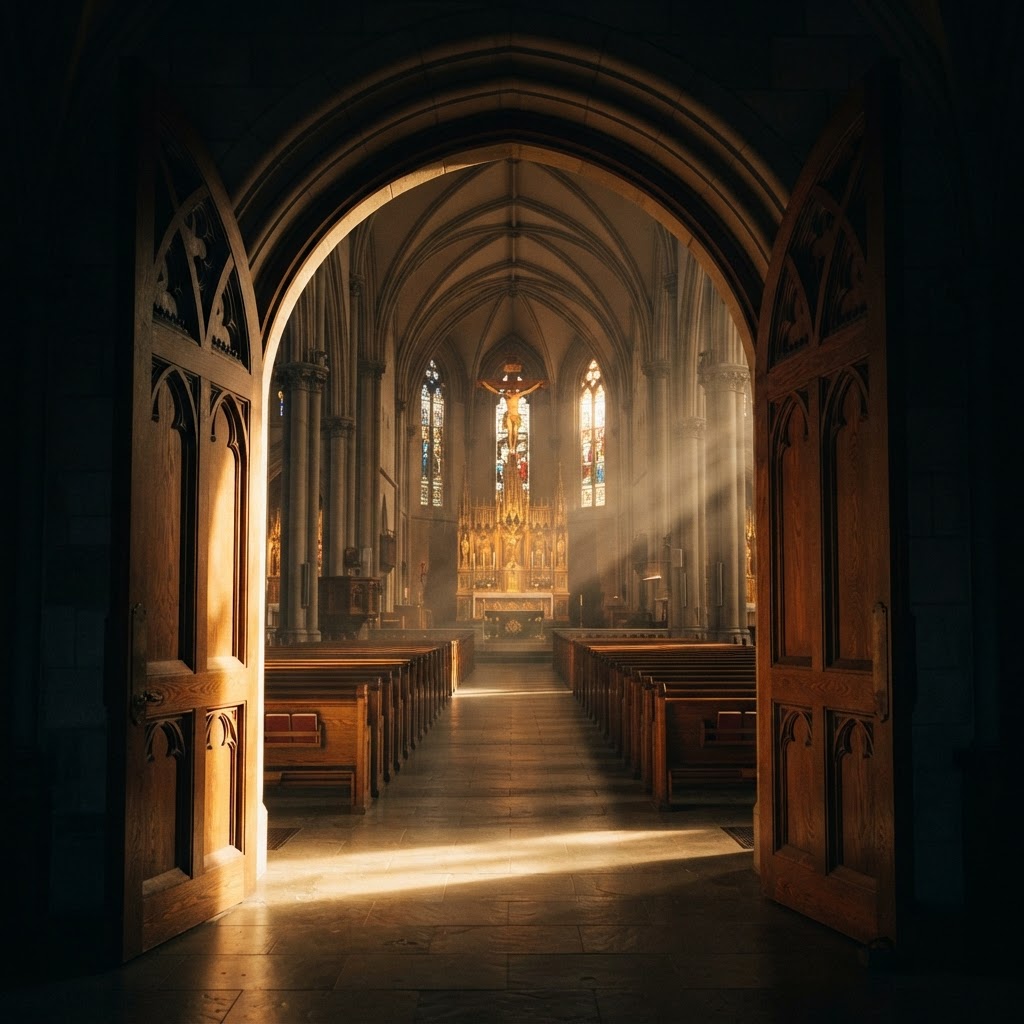
You don't have to have everything figured out before walking through the doors of a Catholic church. Every Catholic journey begins somewhere.
Frequently Asked Questions
What is the Rosary?
The Rosary is a Scripture-based prayer in which Catholics meditate on the key moments of the life, death, and Resurrection of Jesus Christ while praying repeated prayers, including the Hail Mary. The beads help keep count and free the mind to meditate on Christ.
Is the Rosary a sacramental?
Yes. The Rosary is both a prayer and a sacramental object. The blessed beads are a sacred sign that helps direct our hearts toward God. The Rosary itself is not magic — it is a tool for prayer and meditation on the life of Christ.
Do Catholics worship Mary when they pray the Rosary?
No. Catholics worship God alone. The Rosary is Christ-centered: every mystery is a moment from the life of Jesus. Mary's role is to lead us closer to her Son, just as she did at the wedding at Cana (John 2:5).
Why do Catholics repeat the Hail Mary so many times?
Like the steady breathing of the body, the repeated prayers calm the mind and allow the heart to meditate on the mysteries of Christ's life. Repetition in prayer is biblical — Scripture tells us to pray without ceasing (1 Thessalonians 5:17).
Is the Rosary in the Bible?
The prayers of the Rosary come directly from Scripture. The Hail Mary is built from the words of the angel Gabriel (Luke 1:28) and Elizabeth (Luke 1:42). The Our Father was taught by Jesus Himself (Matthew 6:9–13). Every mystery is a biblical event.
Do you have to be Catholic to pray the Rosary?
No. Anyone may pray the Rosary. Many Christians who are not Catholic find it a beautiful way to meditate on the life of Jesus. It can be a wonderful place to begin if you are exploring the Catholic faith.
Thinking About Becoming Catholic?
You don't have to have it all figured out before you begin.