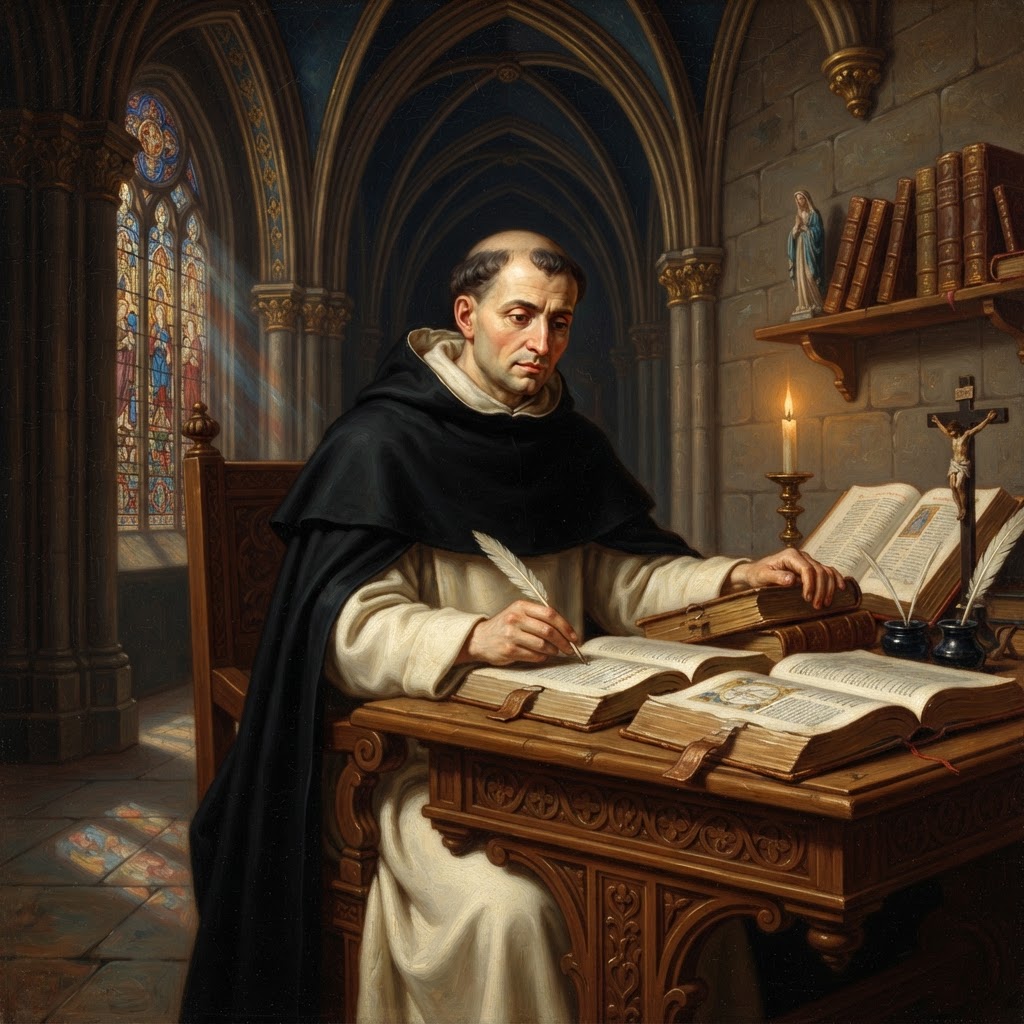
Faith Is Not Opposed to Reason
Can Reason Lead Us to God?
St. Thomas Aquinas & The Five Ways
Nearly 800 years ago
St. Thomas Aquinas presented five philosophical arguments — now famously called The Five Ways — showing how reason can begin with the world we observe and arrive at the necessity of God. Christianity does not ask us to shut off our minds. It asks us to use them.
Who Was St. Thomas Aquinas?
Faith Has Nothing to Fear From Reason
St. Thomas Aquinas was a Dominican priest, philosopher, theologian and one of the greatest intellectual figures in the history of Christianity. He was born around 1225 near Aquino, Italy, and as a young man entered the Dominican Order despite fierce opposition from his family.
His family had other plans for him. Thomas had other plans. More importantly, Thomas believed God had other plans.
His decision to become a Dominican was so unacceptable to members of his family that they detained him in an effort to prevent him from continuing his vocation. It didn't work.
Thomas eventually continued his studies, studying under another future saint and intellectual giant: St. Albert the Great.
Thomas became a teacher, theologian and extraordinarily prolific writer. His greatest work was the:
Summa Theologiae
The Summa attempted something breathtaking: to organize and explain Christian theology systematically while carefully examining objections, philosophy, Scripture, reason and revelation.
Thomas did not simply state conclusions. Again and again he asked questions. He presented serious objections. He considered opposing arguments. Then he answered them. That method remains one of the remarkable characteristics of his work.
The "Dumb Ox"
A quiet giant — and a prophecy that came true
Thomas apparently wasn't the person dominating every conversation. He was quiet. Large. Reserved. Some fellow students reportedly mocked him as the "Dumb Ox."
His teacher, St. Albert the Great, recognized something they didn't. Albert reportedly predicted that the voice of this "ox" would someday be heard throughout the world. He was right.
Nearly eight centuries later, students of philosophy and theology are still studying Thomas Aquinas.
Aquinas and Aristotle
Truth is truth — wherever it is found
Aquinas was deeply influenced by the ancient Greek philosopher Aristotle. This is extremely important. Thomas did not believe Christians should be frightened by philosophy simply because its author wasn't Christian. Truth is truth.
Aquinas employed philosophical ideas concerning actuality and potentiality, causation, being, essence, existence, goodness, purpose and human nature — and incorporated them into an extraordinary Christian philosophical and theological system.
For Aquinas, reason and revelation ultimately cannot contradict one another because truth cannot contradict truth.
Can We Know God Exists Without the Bible?
The question Aquinas answers before he begins
Aquinas believed we can. That does not mean he thought everything about God could be discovered through philosophy. Christian mysteries such as the Trinity and Incarnation require divine revelation.
But Aquinas argued that certain truths about God — including that God exists — can be reached through natural human reason. That distinction is enormously important.
Imagine meeting someone who says: "I don't believe the Bible, so don't use the Bible to prove God exists." Aquinas does not have to begin by saying, "But the Bible says..." He can begin with something both people can observe:
Reality exists.
Things change. Things cause other things. Things exist but do not have to exist. We recognize degrees of perfection. Nature behaves in ordered and intelligible ways.
Then Aquinas asks: What must ultimately be true for reality like this to exist at all?
That brings us to:
The Five Ways
Click each number to explore the argument
Common Misunderstandings
What Aquinas actually argued — and what he didn't
Did Aquinas Think He Had Explained Everything About God?
The Five Ways are a beginning, not the whole journey
No. This is extremely important. The Five Ways occur very early in the Summa Theologiae. They establish the beginning of an argument.
Aquinas then spends considerable time asking: What must this First Cause be like? He argues subsequently about God's simplicity, perfection, goodness, infinity, immutability, eternity, unity, knowledge, will, love and providence.
The Five Ways therefore shouldn't be treated as five independent attempts to prove every Christian doctrine simultaneously. Aquinas isn't arguing: "There is change; therefore Jesus rose from the dead." That would obviously be a gigantic logical leap.
Instead: Reason begins the journey. Revelation tells us much more.
Faith and Reason
Perhaps Aquinas's greatest gift to Christianity
Catholics do not have to choose between faith and reason. Reason can discover truth about the created world and even reach certain truths concerning God. But reason has limits. God reveals truths humanity could never discover completely on its own.
The Trinity is not something we could derive from physics. The Incarnation isn't something Aristotle could have deduced. The Resurrection is a historical and revealed Christian claim. Grace cannot be placed under a microscope.
But none of that means Christianity is irrational. Catholic Christianity has historically insisted that faith and reason belong together.
Meet Thomas
Fascinating facts about the Angelic Doctor
The Dumb Ox
Thomas was large and quiet. Fellow students reportedly mocked him as the "Dumb Ox." His teacher, St. Albert the Great, predicted that the voice of this ox would one day resound throughout the world. It did.
The Summa
His greatest work, the Summa Theologiae, attempted to organize and explain Christian theology systematically — examining objections, philosophy, Scripture, reason and revelation.
His Family Opposed His Vocation
Thomas's wealthy family so opposed his decision to become a Dominican that they detained him in an effort to stop him. It didn't work. He refused to abandon his vocation.
Student of St. Albert the Great
Thomas studied under St. Albert the Great, who recognized his brilliance when others underestimated him. Both men would eventually be canonized and named Doctors of the Church.
Devotion to the Eucharist
Thomas had a profound devotion to the Eucharist. Tradition associates him with some of the Church's greatest Eucharistic hymns, including Pange Lingua, Tantum Ergo, and O Salutaris Hostia.
Prolific Writer
His surviving works include the Summa Theologiae, Summa Contra Gentiles, biblical commentaries, Aristotelian commentaries, disputed questions, sermons and more — all accomplished before dying at just 49.
"All Seems Like Straw"
Near the end of his life, after a profound mystical experience, Thomas largely stopped writing. He told his secretary that everything he had written seemed like straw compared to what had been revealed to him.
Doctor of the Church
Canonized in 1323 and declared a Doctor of the Church, he is known as the Angelic Doctor (Doctor Angelicus). His feast day is January 28. He is a patron of students, scholars and Catholic schools.
Aquinas and the Eucharist
His theology was worship, not merely study
Thomas Aquinas had a profound devotion to the Eucharist. Tradition associates him with some of the Church's greatest Eucharistic hymns. Among them are texts associated with the Feast of Corpus Christi, including Pange Lingua, from which comes Tantum Ergo, and the celebrated O Salutaris Hostia from Verbum Supernum Prodiens.
His Eucharistic writing was not merely academic theology. For Thomas, theology ultimately concerned the God whom he worshiped.
"All That I Have Written Seems Like Straw"
One of the most beautiful lessons Aquinas ever gave
Near the end of his life, something extraordinary happened. In December 1273, after celebrating Mass, Thomas underwent an experience that profoundly affected him. Afterward, he largely stopped writing.
According to the traditional account, when his friend and secretary Reginald urged him to continue his enormous Summa, Thomas indicated that he could write no more and that what he had written seemed like straw compared with what had been revealed to him.
Think about that. One of Christianity's greatest intellectual minds had spent his life reasoning about God. And near the end of that life he was reminded that God is infinitely greater than our words about Him.
That may be one of the most beautiful lessons Aquinas ever gave us. Not another argument. Humility.
His Final Journey
In 1274, Pope Gregory X called Thomas to participate in the Second Council of Lyon. Thomas set out for the council. He never arrived.
Already in poor health, he became seriously ill during the journey and was taken to the Cistercian Abbey of Fossanova. There he died on March 7, 1274. He was approximately 49 years old.
Saint. Doctor. Teacher.
Thomas Aquinas was canonized in 1323. He would later be declared a Doctor of the Church. He is traditionally known as the Angelic Doctor — Doctor Angelicus.
His feast day is celebrated on January 28. He is also recognized as a patron of Catholic schools, universities, students and scholars.
Aquinas Is Not Just for Scholars
You don't need a philosophy degree to learn from Thomas
It is easy to look at Thomas Aquinas and think: "That's for philosophers." Or: "I'm not smart enough for that." Don't make that mistake.
You don't have to understand every technical term in the Summa to learn something from Aquinas. His basic attitude toward truth is extraordinarily useful:
Ask questions. Listen to objections. Don't be afraid of difficult arguments. Think carefully. Define your terms. Follow reason wherever it leads. Recognize the limits of reason. And never confuse knowing things about God with actually knowing God.
That last distinction may be the most important. A person could memorize every page Aquinas ever wrote and still fail to love Jesus Christ. Thomas himself understood that. Theology should ultimately lead us toward God — not merely toward more theology.
The Life of St. Thomas Aquinas
Click a moment to highlight it on the journey
Questions & Answers
Straight answers to the most common questions
Did Thomas Aquinas really prove God exists?
Aquinas believed God's existence can be demonstrated philosophically from effects that are evident to us. Whether a particular reader finds those demonstrations successful is a philosophical question that continues to be debated. Catholics should therefore understand the actual arguments rather than claiming that Aquinas offered a scientific experiment proving God.
Are the Five Ways scientific arguments?
Not primarily. They are metaphysical and philosophical arguments. Aquinas is asking questions deeper than the mechanisms studied by the natural sciences. Science might explain how one physical state develops from another. Aquinas is asking what ultimately makes dependent existence, causation and change possible at all.
Does Aquinas argue that "everything has a cause"?
No. This is one of the most common misunderstandings. If Aquinas believed absolutely everything required a cause, then God would require a cause too. His argument concerns things whose actuality, causation or existence is dependent. God is proposed as the ultimate non-dependent source.
Is the Big Bang the First Cause?
Don't equate them. Aquinas's First Cause is a metaphysical conclusion. The Big Bang is part of a scientific account of the universe's physical history. Even a universe with an indefinitely long physical past would not automatically eliminate Aquinas's deeper question about why dependent reality exists and operates at all.
Did Aquinas believe faith was unnecessary because reason could prove God?
No. Reason cannot independently discover every truth of Christianity. Aquinas distinguished truths accessible to natural reason from mysteries known because God revealed them. Faith goes beyond reason. It does not require us to abandon reason.
Final Reflection
Don't Be Afraid to Ask Why.
Why does anything exist? Why can things change? Why does causation work? Why is nature intelligible? Why does the universe exhibit order? Why is there something rather than nothing?
Catholicism does not respond: "Stop asking questions and just believe."
Some of the greatest minds in Christian history spent their entire lives asking those questions. St. Thomas Aquinas was one of them.
His answer was not that reason replaces faith. His answer was that properly used reason can point beyond itself — toward the source of being, toward the First Cause, toward the Unmoved Mover, toward the Necessary Being, toward the supreme source of goodness, toward the Intelligence behind the order of nature.
Toward God.
Primary Sources & Further Reading
Read Aquinas and the Church directly
Continue the Journey
Keep exploring the Catholic faith
Thinking About Becoming Catholic?
You don't have to have it all figured out before you begin.