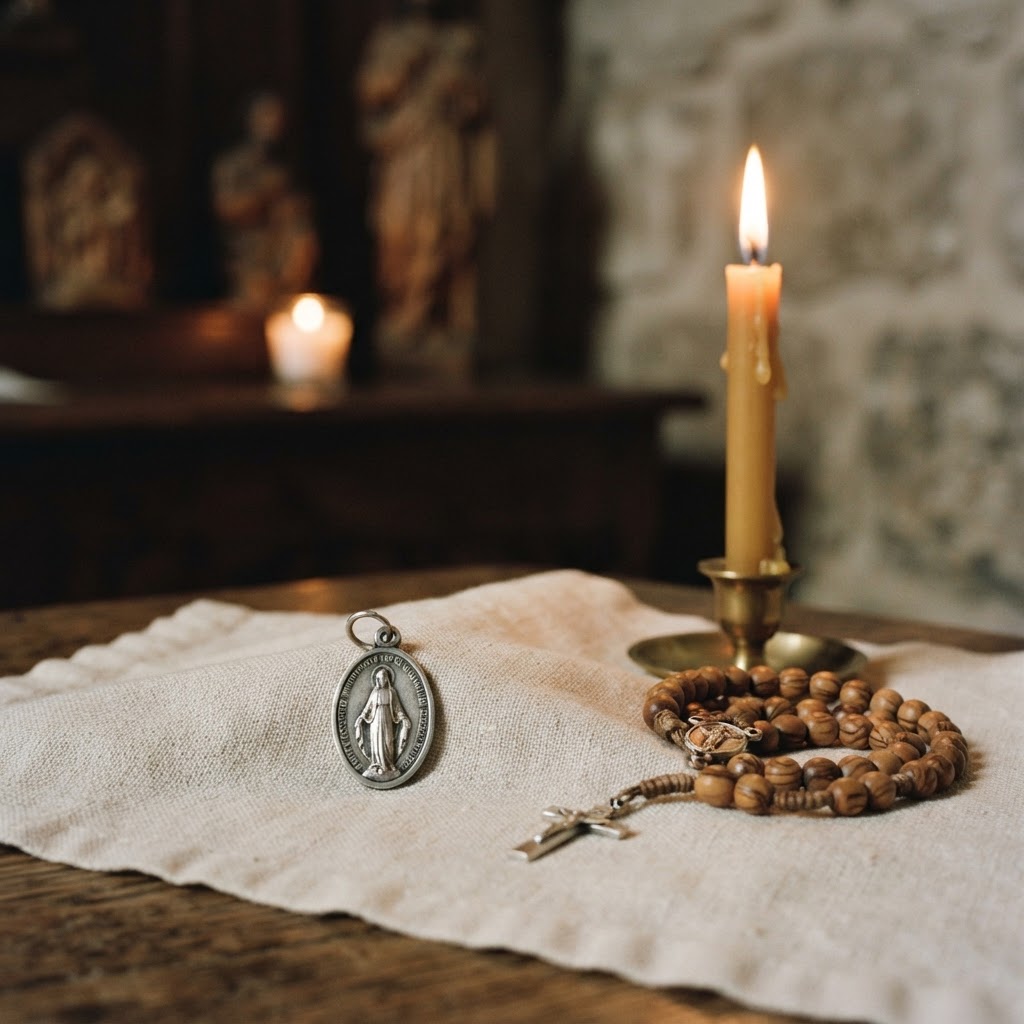
The Miraculous Medal
A Small Medal. A Beautiful Story. A Reminder to Trust in God.
New to Catholicism?
The Miraculous Medal isn't magic, and Catholics don't worship Mary. It's a sacramental — a physical reminder of God's grace, Mary's prayers and our call to follow Jesus Christ.
You may have seen a Catholic wearing a small oval medal around his or her neck. On the front is the Blessed Virgin Mary, standing with her arms extended and rays flowing from her hands. On the back are a cross, the letter “M,” two hearts, and twelve stars.
This is called the Miraculous Medal.
If you are new to Catholicism, you might naturally wonder: What is it? Why do Catholics wear it? Do Catholics believe the medal itself performs miracles? And why is Mary on it instead of Jesus?
Those are good questions.
The Miraculous Medal is not a magic charm. It is not a good-luck piece. Catholics do not worship the medal, and we do not believe a piece of metal has supernatural power of its own. It is a sacramental — a sacred sign that helps turn our hearts and minds toward God.
And behind this tiny medal is a remarkable story.
The Story Begins in Paris
In 1830, a young religious sister named Catherine Labouré was living with the Daughters of Charity of St. Vincent de Paul in Paris, France. Catherine reported several extraordinary encounters with the Blessed Virgin Mary.
On November 27, 1830, Catherine described seeing Mary standing upon a globe. Rays of light streamed from rings upon her fingers, representing graces God desired to give. Around Mary appeared the words:
“O Mary, conceived without sin, pray for us who have recourse to thee.”
Catherine then saw what would become the reverse side of the medal: an M joined with a cross, surrounded by twelve stars, with the Sacred Heart of Jesus and the Immaculate Heart of Mary below.
Catherine understood that a medal was to be made according to this design. After investigation and approval by Church authorities, the first medals were produced in 1832. They spread rapidly.
As reports of conversions, answered prayers and extraordinary graces became associated with the devotion, people began referring to what had originally been called the Medal of the Immaculate Conception by another name: The Miraculous Medal.
A Brief Timeline
1806
Catherine Labouré is born
1830
Catherine reports the apparitions of the Blessed Virgin Mary in Paris
1832
The first medals are struck and distributed
1854
The Church solemnly defines the dogma of the Immaculate Conception
Today
Catholics throughout the world continue the devotion
But Is the Medal Magic?
No. This distinction is extremely important.
A Miraculous Medal is not a Catholic version of a lucky charm. The Catholic faith condemns superstition — the idea that an object possesses some magical power independent of God. The medal points beyond itself.
Think about a wedding ring. The ring does not create a marriage. The metal itself does not love your spouse. But the ring represents something real and can remind the person wearing it of promises, love, sacrifice and faithfulness. A crucifix works similarly. Christians don't believe wood or metal saves us. Jesus Christ saves us. The crucifix reminds us of Him and of what He did for us.
The Miraculous Medal is another physical reminder. It reminds us of Mary. And Mary always points us toward Jesus Christ.
Is the Miraculous Medal Magic?
No.
A Miraculous Medal has no magical power. Catholics trust in God alone. The medal is a sacramental that reminds us of our faith and directs our hearts toward Christ.
What Is a Sacramental?
The Catholic Church uses the word sacramental for certain sacred signs and devotional objects that help prepare us to receive God's grace and live our faith more deeply.
- ✦ Crucifixes
- ✦ Holy water
- ✦ Blessed palms
- ✦ Rosaries
- ✦ Scapulars
- ✦ Sacred medals
But sacramentals are different from the seven Sacraments instituted by Christ. A medal does not replace Baptism. It does not replace Confession. It does not replace the Eucharist. And it certainly does not replace a relationship with Jesus Christ.
Instead, sacramentals help direct our attention toward God and remind us to live the faith we profess.
What Does It All Mean?
Every part of the Miraculous Medal teaches something. Explore the front and the back below — tap any symbol to learn its meaning.
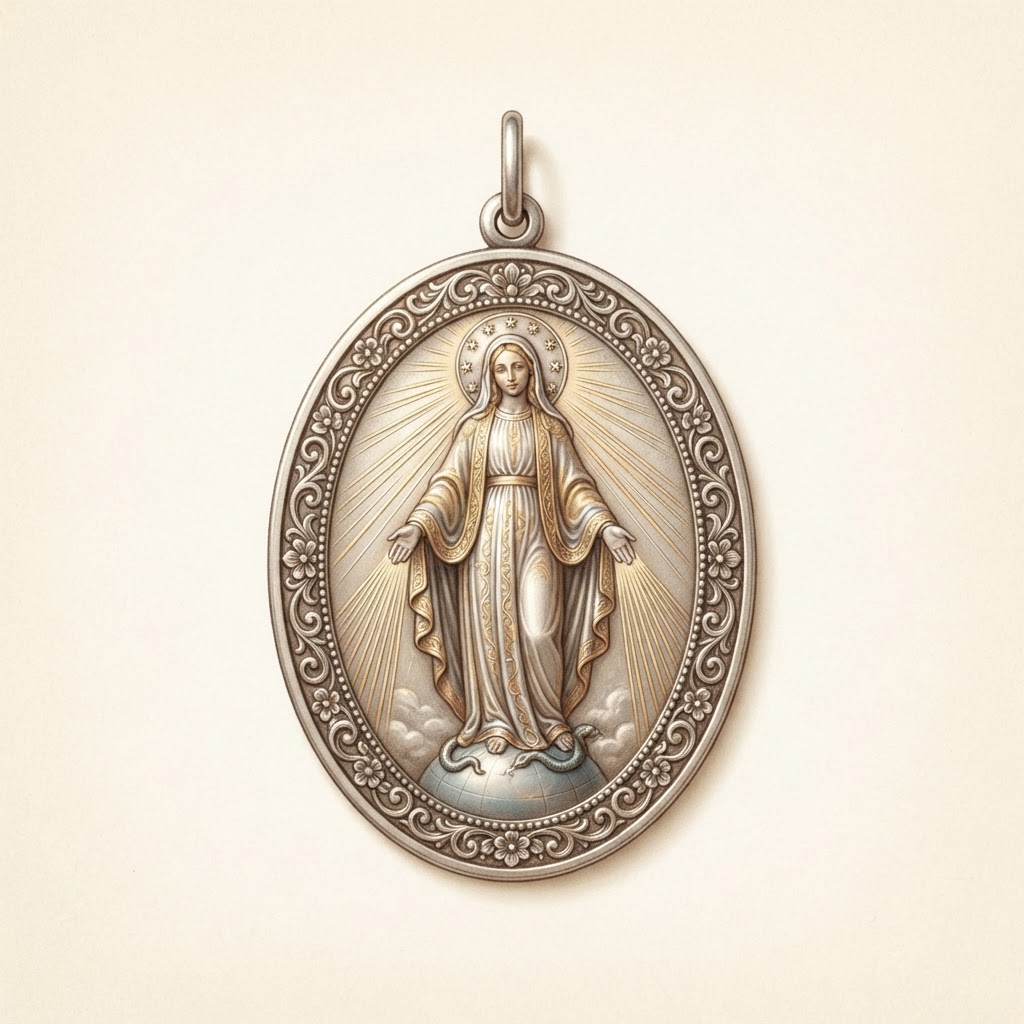
The Front
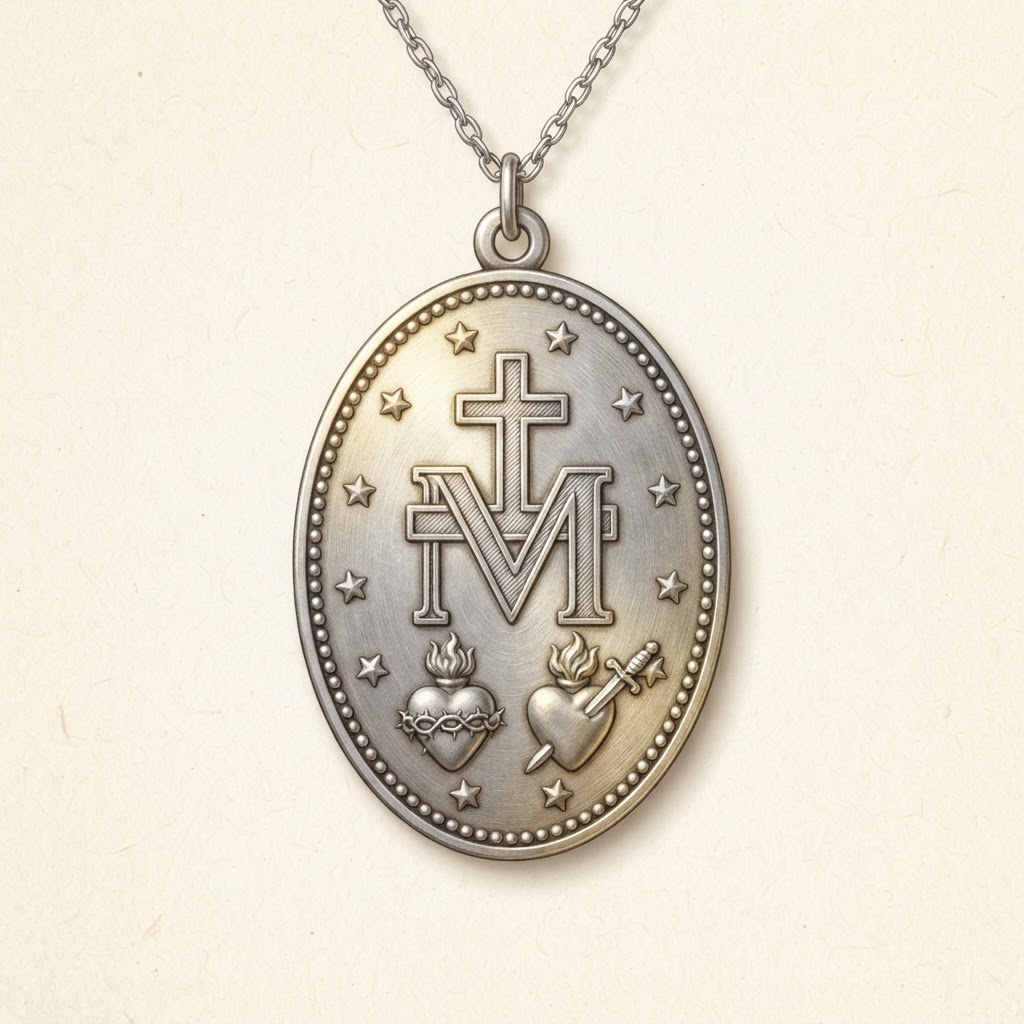
The Back
Mary
Mary stands with her arms open and extended. Catholics honor Mary because God chose her to be the mother of Jesus Christ. She is not a goddess and is not equal to God — she is a human being completely dependent upon God's grace, yet given an extraordinary role in salvation. Her posture reminds us of her maternal care and intercession.
Tap a symbol on either side to learn what it means.
“O Mary, Conceived Without Sin…”
This refers to the Catholic doctrine of the Immaculate Conception. This doctrine is often misunderstood.
The Immaculate Conception does not refer to the conception of Jesus. It refers to Mary's conception. Catholics believe that, through the merits of Jesus Christ and by a unique gift of God's grace, Mary was preserved from original sin from the first moment of her existence.
She still needed a Savior. Her Savior was Jesus Christ. Catholic teaching is that Christ's saving grace was applied to Mary in a unique and preventative way.
The doctrine would be solemnly defined by Pope Pius IX in 1854, twenty-four years after the apparition reported by St. Catherine.
Mary in Scripture
The imagery of the medal is woven throughout the Bible. From the first promise of a Savior, Mary's role was hidden in God's plan — and the medal's symbols echo Scripture from Genesis to Revelation.
Why Do Catholics Ask Mary to Pray for Them?
This may be the biggest question for someone investigating Catholicism. Catholics do not pray to Mary because we believe she is God. She isn't.
Catholics ask Mary to pray for us because we believe the members of Christ's Church remain united in Him. If you were struggling with something difficult, you might ask a Christian friend, “Will you pray for me?” Catholics believe death does not destroy the Body of Christ. Those who are alive with Christ in heaven have not stopped loving God or loving us.
So when a Catholic says, “Mary, pray for me,” we are asking for intercession. The distinction is simple: We worship God. We ask the saints to pray with us and for us. And among all the saints, Mary holds a unique place because she is the mother of Jesus.
Why Wear a Miraculous Medal?
A Catholic might wear one for many reasons. It can be a reminder to pray. A reminder to resist sin. A reminder of Mary's intercession. A reminder that we belong to Christ. A reminder to trust God's grace when life becomes difficult.
And sometimes it becomes something even simpler: a reminder that you are not walking through life alone. Every time your hand touches the medal around your neck, it can become an invitation: turn your heart back toward God. Pray. Trust. Repent when necessary. Ask Mary to pray for you. And follow her Son.
Do I Need to Be Catholic to Wear One?
No. Someone who is exploring Christianity or considering becoming Catholic can certainly wear a Miraculous Medal. In fact, it can become a simple invitation to prayer. You don't have to understand every Catholic teaching before beginning to ask God to lead you.
You can simply pray: “Jesus, if the Catholic faith is where You are leading me, show me. Give me the courage to follow the truth wherever it leads.” And you can ask Mary: “Mary, Mother of Jesus, pray for me. Help me know and follow your Son.” That is a beautiful place to begin.
Should the Medal Be Blessed?
Catholics traditionally have religious medals blessed by a Catholic priest or deacon. The blessing does not turn the medal into a magical object. Rather, the blessing dedicates the object to sacred use and asks God to bless the person who uses it faithfully.
If you have a Miraculous Medal that has never been blessed, simply bring it with you to a Catholic parish and ask a priest or deacon if he would bless it. Don't worry if you aren't Catholic. Just tell him you're learning about the faith. He'll understand.
A Simple Prayer
If you're wearing a Miraculous Medal, you don't need an elaborate prayer. The prayer written directly on the medal is a wonderful place to start:
O Mary, conceived without sin,
pray for us who have recourse to thee.
Then speak to Jesus. Tell Him what you're afraid of. Tell Him where you've failed. Tell Him what you don't understand. Ask Him for forgiveness. Ask Him for faith. Ask Him to show you the truth. And then be willing to follow where He leads.
The Medal Always Leads Beyond Itself
The Miraculous Medal isn't really about jewelry. It isn't ultimately even about the medal. It points toward something much bigger. Mary points toward Christ. Christ points us toward the Father. And through Christ, we are invited into a life of grace — through faith, repentance, Baptism, the Eucharist, Confession, prayer and life within His Church.
So if someone gives you a Miraculous Medal, don't simply put it in a drawer. Look at it. Learn what the symbols mean. Wear it if you wish. And let that little piece of metal ask you a much bigger question: Where is God calling you?
Want to Learn More?
Who Is Mary?
Learn why Catholics honor the Mother of Jesus and what the Church actually teaches about Mary.
Learn About Mary →How Do I Become Catholic?
If you feel God drawing you toward the Catholic Church, learn what the next steps look like.
Becoming Catholic →What Is OCIA?
Learn about the process through which adults explore the Catholic faith and prepare to enter the Church.
Learn About OCIA →The Brown Scapular
Explore another beloved Catholic sacramental — two pieces of cloth and a centuries-old devotion to Our Lady of Mount Carmel.
Explore the Brown Scapular →Are You Exploring the Catholic Faith?
You don't have to have everything figured out before walking through the doors of a Catholic church. Every Catholic journey begins somewhere.
Frequently Asked Questions
What is a Miraculous Medal?
The Miraculous Medal is a Catholic sacramental associated with the apparitions of the Blessed Virgin Mary reported by St. Catherine Labouré in Paris in 1830. Its imagery reminds Christians of God's grace, Mary's intercession and the saving work of Jesus Christ.
Is the Miraculous Medal magic?
No. Catholic teaching rejects superstition. The medal has no magical power of its own. It is a sacramental intended to encourage prayer, faith and trust in God.
Do Catholics worship Mary when they wear the Miraculous Medal?
No. Catholics worship God alone. Catholics honor Mary as the mother of Jesus and ask for her prayers and intercession.
Do you have to be Catholic to wear a Miraculous Medal?
No. Someone exploring Catholicism may wear one as a reminder to pray and seek Jesus Christ.
Should a Miraculous Medal be blessed?
Catholics traditionally ask a priest or deacon to bless religious medals before using them devotionally, although an unblessed medal may still be worn.
What prayer is written on the Miraculous Medal?
“O Mary, conceived without sin, pray for us who have recourse to thee.”
Thinking About Becoming Catholic?
You don't have to have it all figured out before you begin.