After nearly thirty years away from the Catholic Church, I believed that being a good person was enough. This reflection explores what I discovered about Jesus, the narrow gate, the Eucharist, Mary, Confession, the sacraments, and the road home — and why coming back to faith changed everything.
A Letter to My Family
For the lost sheep I love.
This was written for my children, my grandchildren, the grandchildren I may never meet, and anyone in my family who may someday find themselves far from God.
I know what it means to be away.
For nearly thirty years, I was away from the Church. During much of that time, I thought I was good enough.
I worked. I loved my family. I tried to treat people fairly. I was not a murderer, a criminal, or someone deliberately trying to harm others.
But I was still a sinner.
I was proud. I was lustful. I was greedy. I was selfish. I excused sins because they seemed normal, and I compared myself to people I thought were worse instead of comparing my life to Christ.
Somewhere along the way, I had convinced myself that being a decent person was enough.
It was not.
After returning to the Church and spending this past year trying to draw closer to Jesus, I have begun to understand just how much I was missing.
I am not writing this as a priest or theologian.
I am writing it as a father and grandfather who wandered for a long time and finally began finding his way home.
If someone I love reads this years from now and finds himself lost, I hope these words leave a trail back.
And if you do not think you are lost, keep reading anyway.
I once thought the same thing.
Chapter 01
Opening Reflection
In the name of the Father, and of the Son, and of the Holy Spirit.
Dear brothers and sisters in Christ,
There is a quiet and dangerous lie that can settle into the human heart—even into the heart of someone who sincerely tries to live a good life.
It is the belief that if we are decent enough, generous enough, disciplined enough, respectable enough—if we avoid the worst sins and try to treat people well—then somehow we have done what is necessary.
We begin to believe that being a good person is the same thing as belonging to Jesus Christ.
It is not.
Good is not enough.
That sounds harsh until we understand what it means.
It does not mean goodness is unimportant.
It means goodness cannot replace God.
Morality cannot replace grace.
Respectability cannot replace repentance.
Being better than someone else cannot save your soul.
Satan is not ultimately threatened by respectability.
He is threatened by surrender to Jesus Christ.
He is not defeated simply because a man is admired by his neighbors, gives to charity, avoids scandal, works hard, loves his family, and behaves honorably.
The devil may be perfectly content with all of that if the same man never kneels before Christ.
But when that man falls to his knees and says:
“Lord, I need You. I have sinned. I cannot save myself. Have mercy on me.”
That is something entirely different.
Because the devil’s great temptation is not always to make us openly evil.
Sometimes it is enough to make us self-sufficient.
If he can persuade us that we are good enough without God, righteous enough without grace, strong enough without prayer, and decent enough without repentance, he has accomplished something far more subtle.
A man does not have to openly worship Satan to become spiritually lost.
He only has to learn to live comfortably without Jesus.
That may be one of the devil’s greatest victories in the modern world.
Not a world filled with people openly pledging allegiance to evil.
A world filled with people saying:
“I’m a good person. Surely that’s enough.”
But Jesus never said:
“Be decent enough.”
He said:
“Follow me.”
And those are very different things.
Chapter 02
Good Compared to Whom?
Our Lord repeatedly confronted this danger in the Pharisees.
Their problem was not that fasting was evil.
Fasting is good.
Their problem was not that tithing was evil.
Giving to God is good.
Their problem was not that obedience to God’s Law was evil.
Obedience is good.
The danger came when outward righteousness became a substitute for a humble heart before God.
Jesus told the parable of the Pharisee and the tax collector for precisely this reason.
The Pharisee stood before God listing everything he had done correctly.
He fasted.
He tithed.
He followed the rules.
And then he did something terribly familiar:
He compared himself to someone worse.
The tax collector stood at a distance and would not even raise his eyes to heaven.
He simply prayed:
“God, be merciful to me, a sinner.”
And Jesus tells us that it was the sinner who went home justified.
That should shake us.
Because many of us have spent years doing exactly what the Pharisee did.
We look around and find someone worse.
I’m not a murderer.
I’m not a thief.
I’m not that guy.
I haven’t done what she did.
I’m a decent person.
And therefore:
I must be all right with God.
I lived that way for years.
But God does not ask me whether I am better than the worst person I can find.
He asks whether I belong to Him.
Christianity is not merely a program for producing respectable people.
Christianity is the rescue of sinners by Jesus Christ.
Scripture tells us:
“For by grace you have been saved through faith, and this is not from you; it is the gift of God; it is not from works, so no one may boast.”
Our good works matter.
Our obedience matters.
Our choices matter.
Jesus commands us to live holy lives.
But our good works are the fruit of grace, not a replacement for grace.
We do not earn the Cross.
We do not earn the Resurrection.
We do not earn adoption as sons and daughters of the Father.
Everything begins with the mercy of God.
Good is not enough.
Because we do not merely need improvement.
We need redemption.
Chapter 03
The Narrow Gate
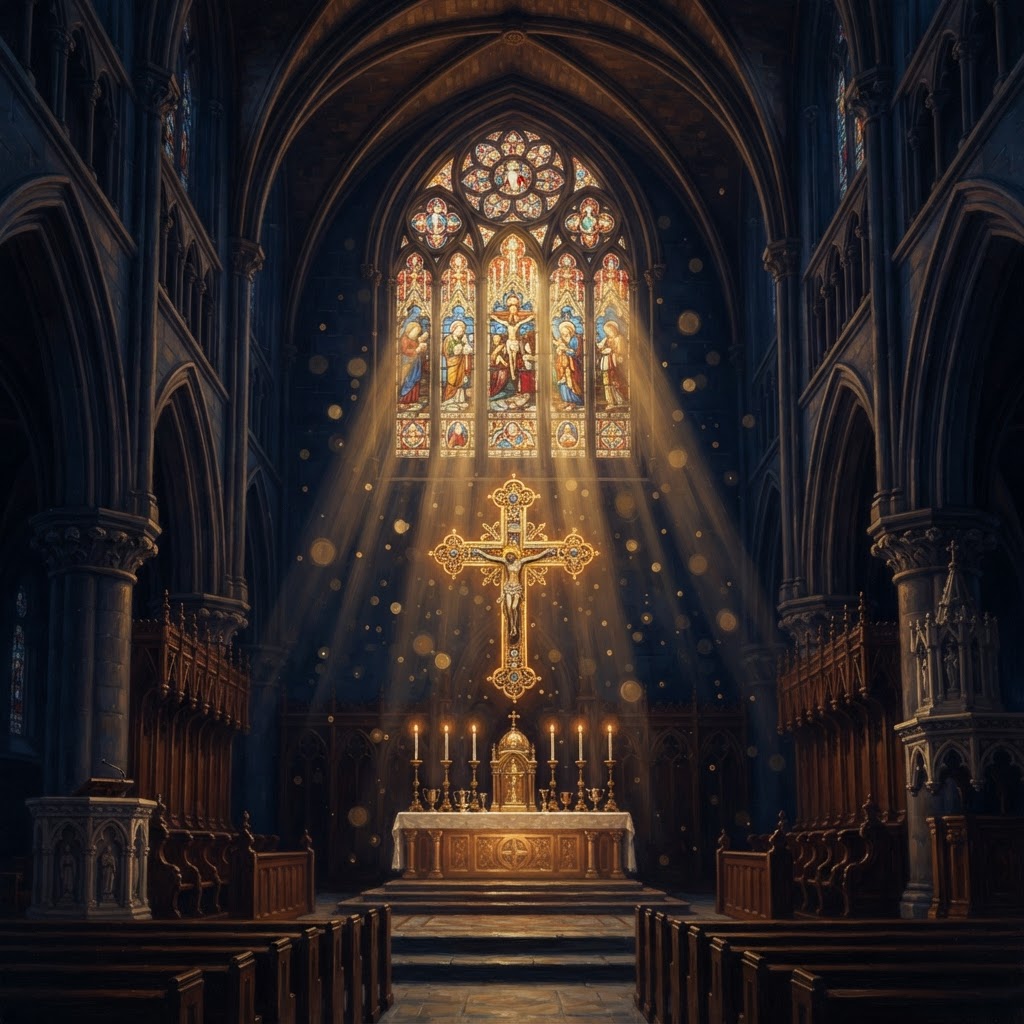
There is another teaching of Jesus that should make every comfortable Christian pay attention.
He speaks about a gate.
Not a wide gate through which everyone casually wanders.
A narrow one.
Jesus says:
“Enter through the narrow gate.”
He warns that the road leading to destruction is broad and that many travel it, while the road leading to life is narrow and few find it.
In another place someone asks Him:
“Lord, will only a few people be saved?”
Jesus does not answer by reassuring everyone that basically decent people have nothing to worry about.
He says:
“Strive to enter through the narrow gate.”
And then He gives the frightening warning that many will try to enter and will not be able.
We should not read those words and despair.
But neither should we explain them away.
Jesus said them because He loves us.
A warning sign beside a dangerous road is not cruelty.
It is mercy.
And Jesus gives us another warning:
“Not everyone who says to me, ‘Lord, Lord,’ will enter the kingdom of heaven.”
Think about that.
Being respectable is not enough.
Calling yourself Christian is not enough.
Knowing religious language is not enough.
Looking holy is not enough.
Simply assuming heaven is automatic is not enough.
Good is not enough.
We need Christ.
We need grace.
We need conversion.
We need a life that actually belongs to Him.
The narrow gate is not Jesus trying to keep us out.
Jesus is the One calling us through it.
But He does not tell us to stand outside admiring the gate and assuring ourselves that we are decent people.
He says:
**Enter.
Follow.
Repent.
Remain in Me.**
Chapter 04
He Gave Us Himself
Morality without Christ cannot save us.
Respectability cannot redeem us.
A good reputation cannot absolve us.
Only Jesus Christ can save.
And here the Catholic faith gives us something astonishing.
Jesus did not merely tell us to remember Him.
He did not merely leave us a philosophy.
He did not merely give us a moral code.
He gave us Himself.
At Capernaum, Jesus spoke words so extraordinary that many of His own disciples could not accept them:
“Amen, amen, I say to you, unless you eat the flesh of the Son of Man and drink His blood, you do not have life within you. Whoever eats my flesh and drinks my blood has eternal life, and I will raise him on the last day. For my flesh is true food, and my blood is true drink. Whoever eats my flesh and drinks my blood remains in me and I in him.”
This is the great mystery at the center of Catholic life.
The Eucharist is not merely a reminder of Jesus.
The Eucharist is Jesus Christ.
**His Body.
His Blood.
His Soul.
His Divinity.**
The same Jesus born in Bethlehem.
The same Jesus who walked the roads of Galilee.
The same Jesus who touched lepers, forgave sinners, raised the dead, suffered under Pontius Pilate, carried the Cross, died at Calvary, and rose from the tomb.
He comes to us under the appearances of bread and wine.
And every worthy reception of Holy Communion is therefore a confession:
I need Him.
I cannot give myself eternal life.
I cannot forgive my own sins.
I cannot conquer death.
I cannot manufacture holiness.
I cannot save myself.
I need Jesus Christ living in me.
That is why good is not enough.
The Eucharist destroys the illusion of self-sufficiency.
We come to the altar not presenting God with our résumé.
We come empty-handed.
We come hungry.
We come dependent.
We come because the life we need is something only He can give.
Chapter 05
The House of Bread
There is something beautiful written into the story of Christ from the very beginning.
Jesus is born in Bethlehem.
Bethlehem means “house of bread.”
And where does Mary place the newborn Christ?
In a manger.
A feeding place.
The Church has long contemplated the profound symbolism contained in this scene.
The One who would later say:
“I am the bread of life”
is born in the house of bread and laid where creatures come to be fed.
Before He ever spoke the words at Capernaum, His birth already pointed mysteriously toward the gift He would someday give His Church.
The Bread of Life came down from heaven.
And Mary held Him in her arms.
Chapter 06
And Then There Is Mary
This brings us to another truth that the Christian world sometimes struggles to understand.
Wherever we encounter the mystery of Jesus, Mary is never far away.
She is there at the Annunciation when the Word becomes flesh.
She is there at Bethlehem when the Savior enters the world.
She is there at Cana when the wine runs out.
And what does she say?
“Do whatever He tells you.”
Those words could summarize the entire mission of Mary.
She points to Jesus.
Someone might look at Mary and think:
Perhaps she was good enough.
She was certainly more holy than I will ever be.
But even here we have to understand something important.
Mary did not save herself either.
Mary was full of grace.
Her holiness was itself a gift from God.
Catholic teaching holds that from the first moment of her existence she was preserved from original sin by a unique grace of Jesus Christ.
Mary too was saved by Christ.
She received His saving grace in an extraordinary and unique way.
That means even the holiest human being who ever lived cannot stand before God and say:
“I accomplished this myself.”
Mary’s entire life says the opposite:
“The Almighty has done great things for me.”
Mary is not the exception to our need for grace.
She is the supreme example of what grace can do when a human being gives God an unreserved yes.
And that may be one reason hell hates her so much.
Mary is the living contradiction of satanic pride.
Satan said, in effect:
I will not serve.
Mary said:
“Behold, I am the handmaid of the Lord. May it be done to me according to your word.”
Satan exalted himself.
Mary humbled herself.
Satan grasped for glory.
Mary received everything as a gift.
Satan rebelled against God’s will.
Mary surrendered herself completely to it.
Satan’s ancient weapon was pride.
Mary answered him with humility.
And God chose this humble young woman from Nazareth to participate in the very event that brought Satan’s defeat into the world.
Chapter 07
The Woman and the Serpent
The first promise of redemption appears almost immediately after the Fall.
God tells the serpent:
“I will put enmity between you and the woman, and between your offspring and hers.”
From the beginning there is a woman.
There is the serpent.
There is enmity.
And there is a child through whom evil will finally be defeated.
The fulfillment is Jesus Christ.
But Mary stands within that mystery in a way no other human being does.
The devil tempted Eve toward distrust and disobedience.
Mary answered God with faith and obedience.
The ancient Christian contrast is powerful:
**Eve listened to the serpent.
Mary listened to the angel.**
Through Eve came the tragedy of disobedience.
Through Mary’s “yes” came the One who would undo that tragedy.
Not because Mary saved the world.
Jesus saved the world.
But God chose that the Savior would enter the world through Mary’s free and faithful cooperation.
Imagine what that means to a creature consumed by pride.
God defeats Satan not through worldly spectacle, not through an earthly army, not through political power—
but through a helpless Child,
born of a humble Virgin,
laid in a manger,
who will one day destroy death by allowing Himself to be nailed to a Cross.
The entire Gospel is an assault on satanic pride.
And Mary stands at the center of that reversal.
Chapter 08
The Rosary and the Battle
That helps explain something Catholics have understood for centuries:
Mary belongs in the spiritual battle.
Why do Catholics turn to the Hail Mary in moments of temptation and spiritual distress?
Why has the Rosary been called a powerful weapon in spiritual warfare?
Not because the words are magic.
Not because the beads themselves frighten demons.
And not because Mary possesses some power independent of Jesus Christ.
Quite the opposite.
Listen to what the Hail Mary actually says:
“Hail Mary, full of grace, the Lord is with thee.” “Blessed art thou among women, and blessed is the fruit of thy womb, Jesus.”
At the very center of the prayer is the name:
Jesus.
And then:
“Holy Mary, Mother of God, pray for us sinners, now and at the hour of our death.”
**Grace.
Jesus.
Sin.
Prayer.
Death.
Our dependence upon God.**
The Rosary takes us even deeper.
Mystery after mystery, we contemplate Christ:
His Incarnation.
His ministry.
His Passion.
His death.
His Resurrection.
His glory.
Again and again, the Christian returns to Jesus Christ.
That is why the Rosary is such a powerful weapon against evil.
Not because Mary replaces Jesus.
Because Mary relentlessly leads us to Jesus.
When the Church must confront evil in its gravest forms, she does not treat the spiritual world as imaginary.
Priests pray in the name of Jesus Christ.
The Cross is raised.
Scripture is proclaimed.
Prayer is offered.
And throughout Catholic tradition, the Rosary and the intercession of the Blessed Virgin Mary have held a special place in that battle.
That should tell us something.
The modern world may laugh at the devil.
The Church does not.
Jesus did not.
And neither should we.
But the lesson is not to become fascinated with demons.
Quite the opposite.
Keep your eyes on Christ.
That is exactly what Mary teaches us to do.
The devil wants our attention turned anywhere except toward Jesus.
Mary keeps turning it back.
“Do whatever He tells you.”
That is why authentic Marian devotion infuriates the enemy.
Because Mary does exactly what Satan does not want done.
She leads souls to Jesus Christ.
Chapter 09
One Christ. One Church.
There is another reason I have become unapologetically Catholic.
Jesus did not leave behind thousands of competing versions of Christianity.
He founded a Church.
One Church.
The Creed says it plainly:
“I believe in one, holy, catholic and apostolic Church.”
The history of Christianity is complicated.
There were disagreements from the beginning.
There were heresies.
There were divisions.
There were painful schisms long before the Protestant Reformation.
The division between East and West developed over centuries.
And after the Reformation, Christian division multiplied dramatically.
Today there are countless Christian communities teaching conflicting things about Baptism, salvation, the priesthood, authority, marriage, Mary, Confession, and even the Eucharist itself.
That should trouble us.
Because Jesus prayed that His followers would be one.
Not that everyone would invent his own Christianity.
Not that truth would become whatever each individual believer decided Scripture meant.
He prayed for unity.
And I have reached a point in my own faith where I am no longer embarrassed or hesitant to say what I believe:
I believe the Catholic Church is the Church Christ founded.
Has she always been perfectly governed?
Absolutely not.
Not even close.
Her history contains weak leaders.
Corrupt leaders.
Scandal.
Sin.
Cowardice.
Terrible decisions.
And men who failed the responsibilities entrusted to them.
But Christianity itself began with sinners.
Peter denied Christ three times.
The apostles argued over which of them was greatest.
Thomas doubted.
Judas betrayed Him.
Jesus never promised that every human being within His Church would behave perfectly.
He promised something far greater:
That the gates of hell would not prevail against His Church.
The sins of men do not erase the truth entrusted to her.
A bad pope does not make Jesus false.
A sinful priest does not make the Eucharist false.
A corrupt bishop does not make Scripture false.
A scandal does not erase apostolic succession.
Human failure does not overturn divine truth.
And that is where I stand.
I do not believe Catholicism is simply one Christian option among thousands.
I believe it contains the fullness of the faith Christ entrusted to His apostles.
I believe in the Eucharist.
I believe in Confession.
I believe in apostolic succession.
I believe Christ gave authority to His Church.
I believe He gave Peter a particular responsibility among the apostles.
I believe the Blessed Virgin Mary is truly our Mother.
I believe the saints are alive in Christ.
I believe the Church on earth remains united with the Church in heaven.
And when Jesus said:
“You are Peter, and upon this rock I will build my church,”
I believe He meant something real.
That does not mean I hate Protestants.
I do not.
It does not mean I think every Protestant is acting in bad faith.
Many love Jesus deeply.
Many know Scripture extraordinarily well.
Many live lives of sincere faith, generosity, and devotion.
The Catholic Church herself recognizes that real elements of truth and sanctification exist outside her visible boundaries.
But respecting another Christian does not require me to pretend our differences do not matter.
They do.
If the Eucharist truly becomes the Body and Blood of Jesus Christ, that matters.
If Christ gave His apostles authority to forgive sins, that matters.
If He established a visible Church and entrusted His teaching to it, that matters.
If He told Peter:
“Whatever you bind on earth shall be bound in heaven,”
that matters.
Truth matters.
After nearly thirty years away from the Church, I am no longer interested in standing outside and criticizing her from a distance.
I came home.
And the more I have learned since returning, the more convinced I have become that I did not merely return to *a* church.
I returned to the Church.
And “good is not enough” applies here too.
It is not enough for me to invent a Christianity that asks little of me.
It is not enough to choose only the teachings of Jesus that I find comfortable.
It is not enough to say:
“I love Jesus, but I will decide for myself what Christianity means.”
That can become another form of self-sufficiency.
Another version of the same old temptation:
I know better.
If Jesus really established a Church, then humility requires me to ask:
Where is it?
And once I believe I have found it, I have another choice.
I can stand outside because some of its members have failed.
Or I can enter, receive what Christ left there, and begin trying to become holy.
I choose to enter.
I am Catholic.
Not because Catholics are better than everyone else.
We clearly are not.
Not because every Catholic leader has been worthy of his office.
History says otherwise.
I am Catholic because I believe Catholicism is true.
And if it is true, then I do not have the luxury of treating it merely as one preference among many.
Good is not enough.
Sincerity by itself is not enough.
Personal preference is not enough.
Even religious enthusiasm is not enough.
I want the truth.
And I believe the truth led me home.
Chapter 10
Why Does the World Keep Attacking What Is Catholic?
There is something else I have begun noticing since returning to the Church.
Christian persecution is not ancient history.
It is happening now.
Christians are still being murdered for following Jesus.
Churches are still being attacked.
Priests and religious are still being kidnapped and killed.
In parts of Africa, Asia, and elsewhere in the world, simply identifying yourself as a Christian can put your life in danger.
Catholics are among those suffering terribly.
And sometimes the things specifically targeted are unmistakably Catholic.
**The priest.
The church.
The altar.
The tabernacle.
The Eucharist.**
That makes me ask a question:
Why?
Why does hatred so often focus on the things at the center of Catholic worship?
Why desecrate an altar?
Why destroy a crucifix?
Why attack a tabernacle?
Why would anyone care about a small consecrated Host unless what it represents—or what Catholics believe it truly is—matters?
A person looking from the outside might see bread.
A Catholic kneels because he believes:
That is Jesus Christ.
**Body.
Blood.
Soul.
Divinity.**
And if there really is a spiritual battle taking place in this world, perhaps we should not be surprised when hatred is directed toward the places where Christ is most explicitly proclaimed and adored.
I have noticed something similar even in popular culture.
Turn on one of the countless television programs about hauntings, possessions, or supposedly evil spiritual activity.
Eventually someone decides they are dealing with something dark.
And who do they so often want?
A priest.
And what does the priest bring?
A crucifix.
Holy water.
Prayer.
Often a Rosary.
Now, television is television.
It is not theology.
Much of it is dramatized, exaggerated, or simply entertainment.
I would never build my faith upon a paranormal television program.
But I still find the cultural instinct interesting.
When people imagine confronting serious spiritual evil, they instinctively reach for ancient Christian things.
A priest.
The Cross.
Holy water.
The Rosary.
The name of Jesus Christ.
Perhaps the world remembers something it claims not to believe.
The Catholic Church certainly remembers.
She has never taught that evil is merely a metaphor.
Jesus confronted evil directly.
And the Church still takes the spiritual battle seriously.
But our focus should never become fascination with darkness.
The answer to darkness is not obsession with the devil.
It is Christ.
The Cross.
The Eucharist.
Prayer.
Grace.
And the Mother who continually points toward her Son and says:
“Do whatever He tells you.”
Once again we arrive at the same truth:
Good is not enough.
Being vaguely spiritual is not enough.
Believing that there might be something “out there” is not enough.
We need Jesus Christ.
Chapter 11
Good Intentions Are Not the Same as Sacramental Grace
There is another part of Catholicism that I did not understand during the years I was away.
The sacraments.
I knew what Baptism was.
I knew people were Confirmed.
I knew Catholics received Communion.
I knew people got married in churches.
But I did not understand what the Church was actually saying.
These are not merely ceremonies marking important moments in our lives.
They are encounters with the grace of God.
The Church teaches that Christ gave us seven sacraments:
**Baptism.
Confirmation.
The Eucharist.
Confession.
Anointing of the Sick.
Holy Orders.
Matrimony.**
They touch the great moments of human life because Christ intends to meet us there.
At our entrance into the life of faith.
As that faith is strengthened.
When we need nourishment.
When we sin.
When we suffer.
When a man gives his life in service to the Church.
When a man and woman give themselves to one another.
And this brings Good Is Not Enough into another part of life.
Take Baptism.
Being born into a loving family is good.
Being raised by good parents is good.
But Jesus gave us something more.
Through Baptism we are brought into new life in Christ and incorporated into His Church.
Good is not enough.
We need grace.
Then Confirmation.
Having good values is good.
Teaching a young person right from wrong is good.
But Confirmation is not merely a Catholic graduation ceremony.
The baptized person is strengthened by the Holy Spirit for Christian life and witness.
Good intentions are not enough.
We need the Holy Spirit.
Then the Eucharist.
Eating together as a family is good.
Remembering Jesus is good.
Reading Scripture about the Last Supper is good.
But Jesus gave us more than a memory.
He gave us Himself.
Good is not enough.
We need the Bread of Life.
Then Confession.
Feeling sorry is good.
Knowing we did something wrong is good.
Trying to do better next time is good.
But Jesus did not merely tell us to privately forgive ourselves.
He gave His apostles authority to forgive sins in His name.
There is an enormous difference between saying:
“I regret what I did”
and kneeling before Christ in the sacrament and hearing:
“I absolve you from your sins.”
Good intentions are not enough.
We need mercy.
We need forgiveness.
We need grace.
And then there is marriage.
This one strikes particularly close to home for me.
Two people can love each other deeply.
They can be faithful.
They can raise children.
They can build a home together.
They can stand before a judge and make promises.
Those things are good.
But for baptized Christians, marriage is meant to be something even greater.
A sacrament.
A covenant before God.
A husband and wife do not simply say:
“We love each other.”
They place that love before Christ and ask Him to enter it.
The Church teaches that Christian spouses receive a particular grace for the duties and dignity of married life.
That changes how I see marriage.
Love is good.
Commitment is good.
Faithfulness is good.
A civil marriage can establish a real legal bond and serious obligations.
But Christian marriage points beyond the couple themselves.
It becomes a sign of Christ’s love for His Church.
The husband is called beyond himself.
The wife is called beyond herself.
Their marriage is called beyond itself.
Christ enters the covenant.
So if one of my children, grandchildren, or descendants ever reads these words while thinking about marriage, I would tell you this:
Do not merely ask God to bless the life you have already decided to build.
Build it with Him from the beginning.
Stand before Him.
Make the covenant before Him.
Ask for the grace you will need when love becomes difficult.
Because it will.
Human love is beautiful.
But human love is fragile.
We become selfish.
We become angry.
We become tired.
We disappoint one another.
We misunderstand each other.
We sin against each other.
There will be days when feelings are not enough.
There will be days when romance is not enough.
There will be days when good intentions are not enough.
You will need grace.
Love is good. But even love is not enough without Christ.
That is not an insult to human love.
It is an admission of how precious marriage is.
It is too important to attempt without God.
The same is true of all the sacraments.
For years, I thought Catholicism was primarily telling me what rules to follow.
Now I see something very different.
Christ was giving me help.
Baptism.
Confirmation.
The Eucharist.
Confession.
Marriage.
Anointing when we suffer.
The sacraments are not burdens God piled onto an already difficult life.
They are gifts He placed along the road home.
They are places where heaven reaches into ordinary human life and says:
You do not have to do this alone.
That may be one of the greatest lessons I have learned since returning to the Church.
God does not simply command us to become holy and then stand at a distance watching us struggle.
He gives us grace.
He gives us His Church.
He gives us the sacraments.
He gives us Himself.
And that is ultimately why good is not enough.
Because God did not create us merely to become better-behaved human beings.
He created us to share in His own divine life.
Chapter 12
Good Is Still Not Enough
And now we return to the beginning.
Satan may be perfectly content to leave many aspects of your life alone.
He may not particularly care that you are successful.
He may not particularly care that your neighbors like you.
He may not particularly care that you donate to charity.
He may not particularly care that you work hard and provide for your family.
He may not even particularly care that you describe yourself as spiritual.
If all of those things convince you that you have no need to kneel before Jesus Christ, they may actually serve his purpose.
You can be polite.
You can be generous.
You can be respected.
You can have a beautiful home.
You can raise successful children.
You can give money to charity.
You can stay out of jail.
You can have an excellent reputation.
And still miss the narrow gate.
That is the frightening truth.
Good is not enough.
But begin going to Confession.
Begin attending Mass faithfully.
Begin sitting silently before the Blessed Sacrament.
Begin receiving the Eucharist worthily.
Begin reading Scripture.
Begin praying with your family.
Begin saying the Rosary.
Begin asking Mary:
“Mother, bring me closer to your Son.”
And something changes.
Because you are no longer merely trying to become a better version of yourself.
You are surrendering yourself to God.
That is the battlefield.
The devil does not fear your résumé.
He fears the Cross.
He does not fear your reputation.
He fears Jesus Christ.
He does not fear that people think you are nice.
He fears that you may become holy.
Chapter 13
Behold Your Mother
Mary is there again at Calvary.
When almost everyone else has fled, Mary remains.
She stands beneath the Cross while the sword foretold by Simeon pierces her heart.
And from the Cross Jesus looks to the beloved disciple and says:
“Behold, your mother.”
Then Scripture tells us:
“From that hour the disciple took her into his home.”
The Church has never forgotten those words.
Neither should we.
Catholics do not honor Mary instead of Jesus.
We honor Mary because of Jesus.
Everything about Mary leads us back to Him.
Her greatness comes from Him.
Her holiness comes from His grace.
Her motherhood exists because the eternal Son of God chose to receive His human nature from her.
No human being ever loved Jesus more perfectly than His Mother.
No human being knew His face more intimately.
No one heard His heartbeat sooner.
No one followed Him longer.
No one stood closer to the Cross.
And no one says more clearly to every generation:
“Do whatever He tells you.”
That is authentic Marian devotion.
Not Mary instead of Jesus.
Mary leading us to Jesus.
Not Mary competing with Christ.
Mary magnifying Christ.
As she herself proclaimed:
“My soul proclaims the greatness of the Lord.”
Chapter 14
The Road Home
The devil would be perfectly content for Christianity to become nothing more than respectable behavior.
Be polite.
Be successful.
Avoid embarrassment.
Appear decent.
Never surrender.
Never repent.
Never kneel.
Never admit that you desperately need a Savior.
That Christianity would threaten him very little.
Because good is not enough.
But a man who kneels before the tabernacle and whispers:
“Jesus, I trust in You”—
A woman who enters the confessional and says:
“Bless me, Father, for I have sinned”—
A family gathered in prayer—
A sinner who returns to Mass after years away—
A Catholic who approaches the Eucharist in a state of grace knowing that the One he receives is truly Jesus Christ—
A disciple who takes Mary into his spiritual home and hears her say again:
“Do whatever He tells you”—
That is something hell fears.
Because that person has stopped trusting himself.
He has begun trusting Christ.
So brothers and sisters, do not merely ask:
“Am I a good person?”
Ask:
“Do I belong to Jesus Christ?”
Do not rest in your reputation.
Do not compare yourself to people who have sinned differently than you.
Do not confuse respectability with holiness.
Do not imagine that avoiding the worst sins means that you no longer need conversion.
And do not stand outside the narrow gate telling yourself that you are probably close enough.
Enter.
We need Jesus.
We need His mercy.
We need Baptism.
We need the Holy Spirit.
We need Confession.
We need prayer.
We need grace.
We need the Eucharist.
We need His Church.
We need the sacraments He gave us.
We need to remain in Him.
Come to the altar hungry for Christ.
Receive Him worthily.
Adore Him in the Blessed Sacrament.
Remain in Him.
And take His Mother into your home.
Ask her to do what she has always done:
Lead you closer to her Son.
Ask her to teach you the humility of Nazareth, the faith of Bethlehem, the obedience of Cana, and the perseverance of Calvary.
And whenever the old lie whispers:
“You’re a good person. Surely that’s enough.”
Remember the narrow gate.
Remember the Cross.
Remember the Eucharist.
Remember the Church Christ founded.
Remember your Baptism.
Remember the grace God has offered you.
Remember the words of Jesus:
“Without me you can do nothing.”
And answer the lie:
No. Good is not enough.
Not because goodness does not matter.
Goodness matters enormously.
Love matters.
Marriage matters.
Family matters.
Generosity matters.
Kindness matters.
Doing what is right matters.
But none of those things were ever meant to exist apart from God.
Goodness separated from the One who is Good cannot save us.
Love separated from the One who is Love will eventually run out of itself.
Human strength separated from grace will eventually discover its weakness.
We were not created merely to become respectable people.
We were created to become saints.
And saints are not people who finally became good enough to save themselves.
They are sinners who finally understood that they could not—
and surrendered themselves completely to the One who could.
Jesus Christ.
May Jesus Christ, truly present in the Most Holy Eucharist, become the center of our lives.
May the Blessed Virgin Mary, Mother of God and our Mother, crush every temptation that would lead us away from her Son and always lead us back to Him.
May we never presume that the broad road is safe simply because many others are walking beside us.
May we seek the narrow gate.
May we remain in Christ.
May we remain faithful to the Church He established.
May we receive with gratitude the sacraments He gave us.
And may we never again believe the lie that we are good enough without Him.
Because without Him, we have nothing.
But with Him—
we have everything.
Amen.
Thinking about returning to the Catholic Church? Start here.
About Letters From Nonno
Faith worth passing down
Letters From Nonno began after its author returned to the Catholic Church following nearly thirty years away.
They are written primarily for his children, grandchildren, future grandchildren, and anyone else who may someday need a trail back to Christ.
They are not intended to replace Scripture, the Catechism, the teaching authority of the Church, or the guidance of a priest.
They are simply one Catholic grandfather passing down what he wishes he had understood sooner.